
Optimize Business for AI Gatekeepers
The Agentic Search Revolution
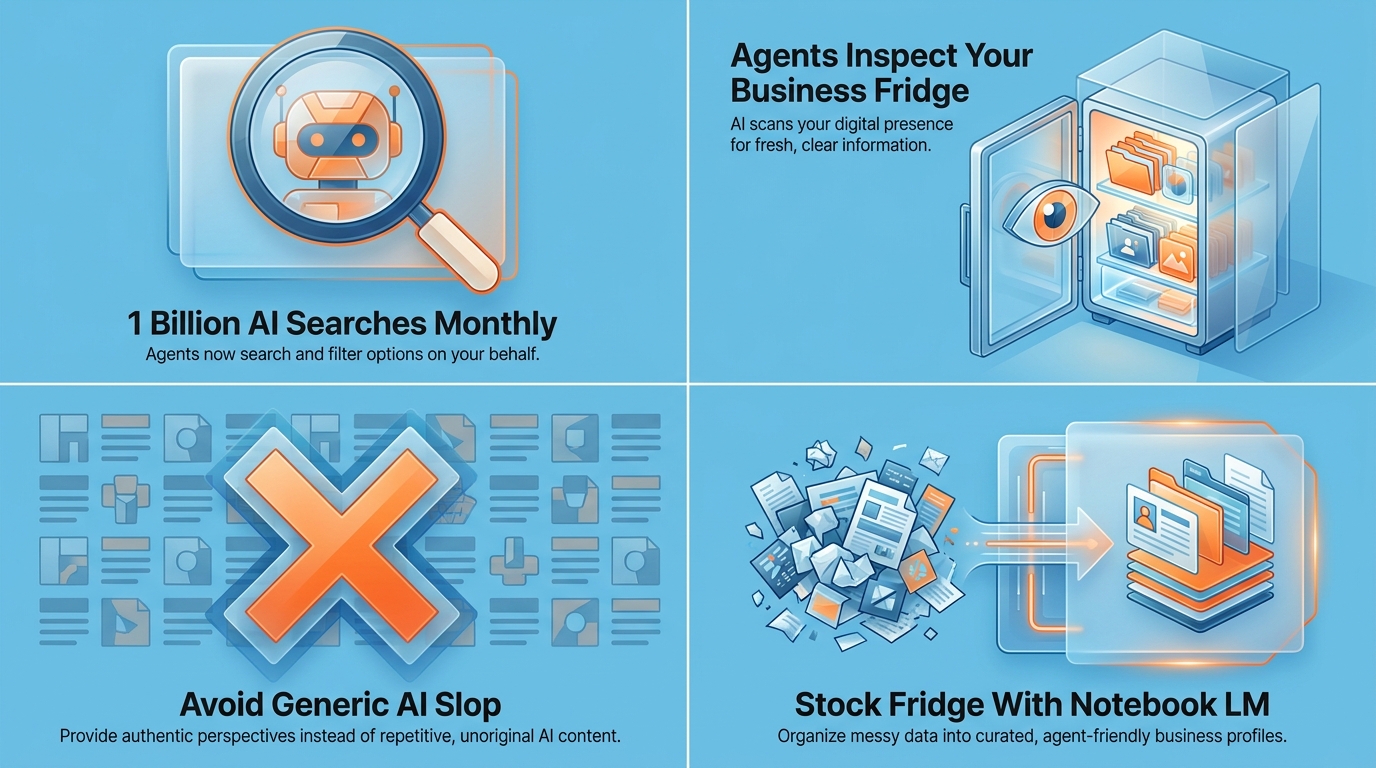
Over one billion AI agent searches are now executed monthly; optimizing for human search behavior is no longer enough to guarantee visibility.
AI agents now act as autonomous gatekeepers, pre-filtering and curating options before your prospective client ever sees a search result.
Businesses suffer from "AI Slop" when their digital presence is stocked with generic data, causing AI agents to silently bypass them.
Using tools like Google's NotebookLM allows non-technical business owners to transform unstructured, messy company data into a highly synthesized, proprietary semantic graph that AI agents trust and recommend.
The Strategic Shift
For the last two decades, the digital growth playbook was predictable. A prospective buyer realized they had a problem, they navigated to a traditional search engine, typed in a few keywords, and manually clicked through a dozen blue links. They parsed the information, weighed the options, and ultimately decided which business was worthy of their time and money.
In this outdated model, the human was doing the heavy lifting. The human was the agent.
But according to Steve ROI Brown, that era has officially ended. We are rapidly transitioning from a search-based internet to an agentic internet. You are already living in an agentic world, whether you realize it or not.
To understand this shift, consider a mundane, everyday problem: buying a new refrigerator. In the old paradigm, the process was labor-intensive. A homeowner would get in their car, drive to big-box hardware stores, wander the aisles, physically measure dimensions, and mentally compare features, only to realize half of their options wouldn't even fit in their kitchen cabinet. It was a massive waste of time and energy.
Today, the modern buyer simply takes a photo of their old refrigerator—blur and all—and uploads it into a multimodal AI platform like Grok or ChatGPT, commanding it to find exact replacements.
Behind the scenes, the AI doesn't just return links. It deploys multiple autonomous sub-agents that go out into the digital ecosystem simultaneously. One agent analyzes the photo to calculate the exact spatial constraints. Another agent scrapes current inventory across multiple local retailers. A third cross-references customer reviews and price points. The agents do the manual labor of researching, filtering, and aggregating. The human user is then presented with a hyper-curated, highly accurate shortlist of the only two or three options that perfectly solve their problem.
This is the strategic shift every business owner must internalize: one billion AI agent searches are already happening every single month. These agents are actively bypassing traditional search pages to aggregate data directly. If your business is relying on the old way of being found, you are invisible to the new gatekeepers.
The Core Philosophy
To survive the agentic search revolution, you must fundamentally change who you are marketing to. You are no longer just optimizing for the human end-user; your first impression is now judged by an autonomous machine.
Steve ROI Brown conceptualizes this through a highly effective mental model known as the "Business Refrigerator Test."
"AI agents are basically coming by and opening the refrigerator, and they're looking inside your business. They're checking whether your offer is clear and whether it fits the needs of the person that is wanting to potentially consider you. If the AI agent is unable to understand what your business is about, it goes zoom. It goes right by, and guess what? You don't show up in the options." — Steve ROI Brown

When humans visit someone's house, it is almost instinctual to want to peek inside their refrigerator. What you find inside tells a vivid story about how that person lives, what they value, and how they operate. If you open a fridge and find it stocked with nothing but old mustard jars, expired leftovers, and generic takeout containers, you immediately form a negative, low-trust opinion of that environment.
Your business's digital footprint is exactly the same. When AI agents open your "business refrigerator" to evaluate you for a potential client, what do they find?
Most companies have a digital fridge full of leftovers. They have generic website copy that sounds exactly like their competitors. They have outdated Google Business Profiles. They possess what the tech industry calls "AI Slop"—homogenized, unoriginal content that lacks perspective, voice, or proprietary insight.
If an AI agent peers into your business and finds a dusty, confusing, generic inventory, it will not trust your data. It will not index your solutions as a viable option for the end-user. You will simply be excluded from the aggregated report. You must shift your philosophy from having a "generic fridge" to a "curated fridge"—a rich ecosystem of fresh, original, and highly organized information that makes the AI agent's decision effortless.
The Implementation Blueprint
Understanding that AI agents are the new gatekeepers is only half the battle. The execution lies in systematically cleaning up your data so that autonomous agents prioritize your business over your competitors.
Fortunately, Steve's approach requires absolutely zero technical coding skills. You do not need to be an AI engineer to master this. You simply need to leverage a data-synthesis tool like Google's NotebookLM to bridge the gap between your raw company knowledge and the structured data AI agents crave.
Step 1: Audit and Consolidate Your Messy Data
The first action step is to gather all the disparate, unstructured information that currently exists inside your organization. Most businesses have their best insights scattered across dozens of different locations: neglected Google Business Profiles, outdated website copy, dormant customer review platforms, and internal onboarding documents that never see the light of day.
The Action: Collect every piece of text, collateral, and client feedback that accurately describes who you serve and the problems you solve.
The Business ROI: By gathering this scattered data, you are preparing to create a centralized "knowledge graph" of your business. As Steve ROI Brown points out, "Whatever is important that should be considered by the human and the AI agents, you dump it into the machine." This prevents AI agents from having to guess what you do, reducing the friction that leads to them skipping your business.

Step 2: Ingest and Synthesize via NotebookLM
Once you have your raw materials, you must process them into a cohesive narrative. NotebookLM is designed to take vast amounts of unstructured text and turn it into a synthesized, interactive knowledge base.
The Action: Upload your collected business data into NotebookLM. Use the platform to distill your complex onboarding processes, client success stories, and operational standards into clear, well-illustrated summaries. Ask NotebookLM to output fresh website copy, service descriptions, and FAQ documents based strictly on your uploaded source material.
The Business ROI: This step forces the AI to understand your business intimately. When you use NotebookLM to organize your company's data, you are effectively packaging your business into a clean, highly readable format. "AI agents are wondering if your business is the right fit," Steve explains. "And so they'll go out, they'll look at your business and based on the information that they find, they'll discern whether you're a good fit to be included in those search results." A properly structured NotebookLM output ensures that when the agents look, they find immediate clarity.
Step 3: Eliminate "AI Slop" by Injecting Proprietary Voice
Structuring your data is vital, but uniqueness is what ultimately secures your place on the AI's shortlist. If your newly organized data reads like every other competitor in your industry, you will still be ignored.
The Action: Review the outputs from NotebookLM and actively inject your distinct industry opinions, your proprietary methodologies, and your unique operational voice. Do not let the AI smooth out the edges of your brand. If you have a specific philosophy on how clients should be treated, ensure it is heavily featured in the text.
The Business ROI: Differentiation is the ultimate competitive advantage in an agentic search ecosystem. AI agents are programmed to seek out the most relevant, authoritative answers for their human users. "If you're not putting your unique opinion in your ingredients and your perspective, then it's just going to spit out the exact same thing that it spits out for everybody else," Steve warns. By stocking your digital fridge with unique, perspective-driven insights, you position yourself as the definitive authority, entirely immune to the trap of generic AI slop.
Step 4: Deploy Freshness Signals Across Your Ecosystem
AI agents prioritize up-to-date information. An abandoned website or a dormant social media profile signals to an autonomous agent that the business might be closed, irrelevant, or unreliable.
The Action: Take the polished, proprietary content you refined in NotebookLM and aggressively deploy it. Update the photos on your Google Business Profile this week. Publish a new blog post written through the lens of your unique perspective. Rewrite your sales leave-behinds and update your LinkedIn company page.
The Business ROI: Continuous deployment creates persistent "freshness signals." When an AI agent scans your business, it sees an active, improving, and highly engaged entity. This drastically increases your trust score within large language models, ensuring that when an AI is tasked with finding a solution in your industry, your business is confidently presented as the premier choice.
See the Strategy in Action
To truly grasp the power of this strategy, you need to see it in action. In the AI Made Simple episode on YouTube, Steve ROI Brown opens up a multimodal AI interface and demonstrates the exact sequence of an agentic search.
By uploading a poorly lit, tightly cropped photo of a refrigerator wedged into a kitchen cabinet, Steve bypasses traditional search entirely. You can watch in real-time as the interface triggers multiple autonomous agents, branching out, running distinct parallel queries, calculating spatial constraints, and fetching inventory data.
This is the ultimate realization of the new digital reality. Steve isn't clicking links. He isn't typing in boolean search modifiers. He is simply stating a complex problem, and the AI agents are doing the grueling manual labor of filtering the world's data on his behalf.
We have officially moved past the era where optimizing for human clicks was the primary driver of digital revenue. The future belongs to businesses that understand how to communicate directly with autonomous AI agents.
Don't let AI agents bypass your business. Watch the latest AI Made Simple episode on YouTube to see Steve break down this strategy in depth, including how NotebookLM can help transform your raw business data into a structured, proprietary asset that AI agents can understand, trust, and recommend.
Ready to Make AI Work Better for Your Team?
Understanding where AI is headed is one thing. Knowing how to use it to make your team better is another.
If you’re not sure where AI fits into your business, where your biggest opportunities are, or how to move from experimenting with AI to actually improving the way your team works, Steve can help.
Set up a Strategy & Clarity Session with Steve to look at your business, identify where AI can make the biggest difference, and map out practical ways to help your team work smarter, communicate better, and get more done.
You don't need to have all the answers before the conversation. That's what the session is for.
Set up your Strategy & Clarity Session with Steve and discover how AI can help your team become better at what they already do.