

AI as Your Storytelling Co-Pilot: How to Turn Complex Value Into Clear, Memorable Assets
If you lead a company with a niche product, you are probably sitting on a mountain of value. You have years of experience, customer insight, and hard earned lessons. The challenge is turning all that into a message people understand in minutes, not weeks. This is where AI can become a true advantage, not as a novelty, but as a practical storytelling co-pilot that helps you communicate with clarity and confidence.
Before we go further, this idea is also covered on the AI Made Simple podcast. You can find the episode on YouTube if you want extra examples of how AI supports clearer leadership and more creative communication.
Storytelling is not just a marketing trick. It is a decision tool. It helps your customer understand why your solution matters and how it fits into their future. And today, AI can help you create story based assets like infographics, slide decks, and one page explanations faster than ever.
Why Story Beats Information Every Time
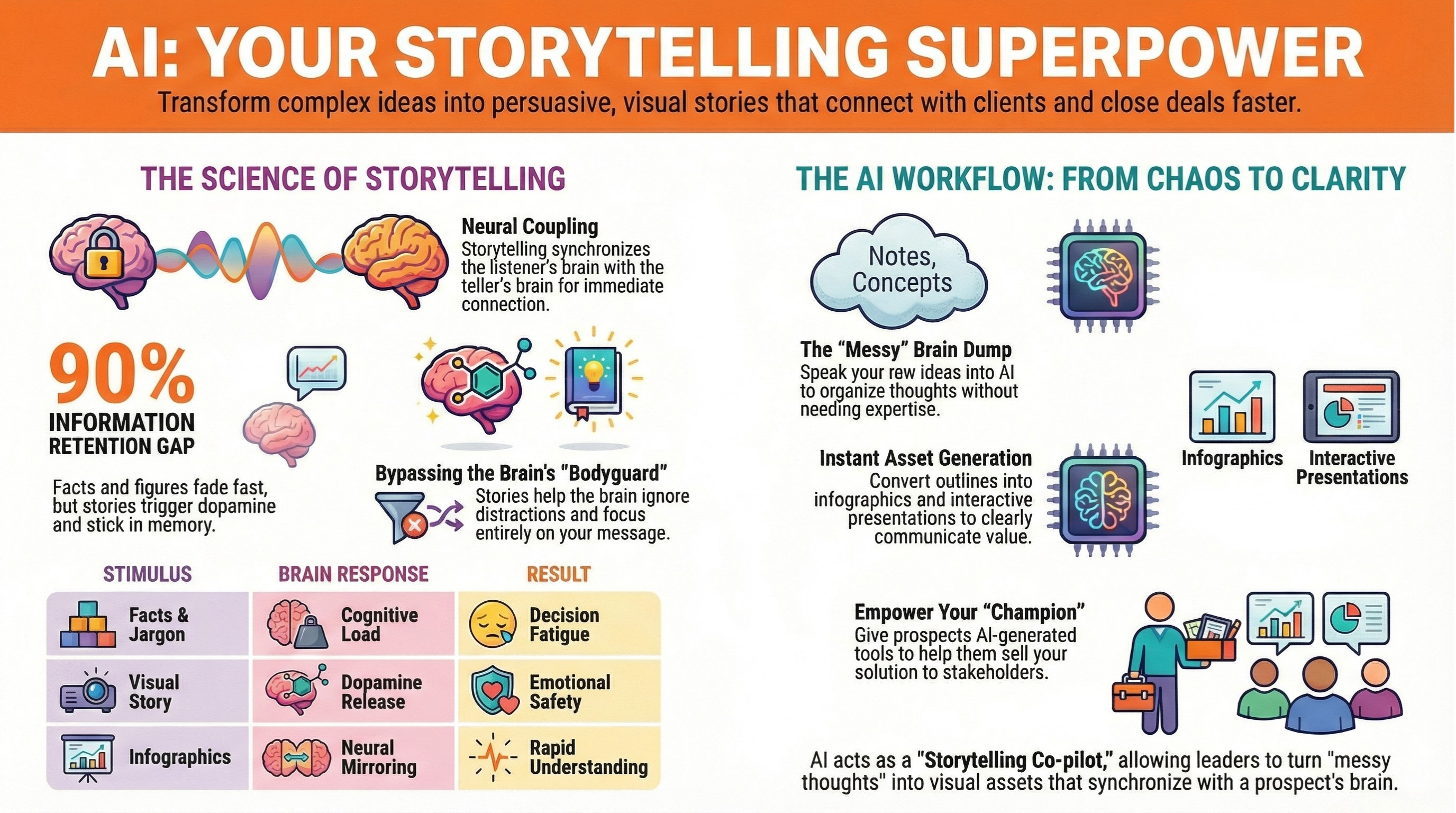
Most businesses already have the facts: features, benefits, pricing, and case studies. The problem is that facts alone fade quickly. People are overwhelmed with information all day. Their brains protect them by filtering, skipping, and forgetting.
A story works differently. A story:
Creates focus because it has a beginning, middle, and end.
Builds emotion, which makes the message stick.
Makes complexity feel simple because it follows a path.
Helps people repeat what they learned in their own words.
When someone feels understood, they relax. When they relax, they listen. When they listen, they remember. And when they remember, they buy and they share.
This is why the company that makes prospects feel safe and understood often wins, even if another option has similar features.
The Old Way Was Slow and Expensive
Traditionally, clear storytelling required a lot of resources.
You would do strategy sessions, write drafts, workshop messaging, then hand it to designers. Then you would revise again and again. If you had a strong marketing team, you could do it. If you did not, you often settled for something that felt “good enough.”
That created a hidden competitive advantage for companies with time, money, and a full team of specialists.
Now AI changes the economics. It does not replace good thinking, but it speeds up the translation from messy ideas into clear assets.
You still need your insight. AI helps shape it into a format other people can quickly understand.
The Real Superpower: Turning a Brain Dump Into a Clear Asset
Most founders and leaders do not struggle because they lack ideas. They struggle because their ideas are too big and too connected.
You might have:
Customer pain points;
Product details;
Industry context;
Proof and results; and a
Vision for the future.
That is hard to explain in a clean way, especially under time pressure.
AI is good at structure. If you give it raw material, it can help you:
Organize your thoughts into a simple outline.
Rewrite in plain language for a specific audience.
Create a narrative that highlights the “why” behind the product.
Generate visual formats like infographic copy, slide text, and captions.
The key is not asking AI to “write marketing.” The key is asking it to clarify meaning.
A practical workflow looks like this:
Dump your thoughts into AI with no pressure to be polished.
Ask it to summarize the core problem your customer faces.
Ask it to explain your solution using simple language and no jargon.
Ask it to turn that into a story with a clear outcome.
Ask it to produce an asset format: slides, infographic sections, one page explainer.
That alone can turn weeks into hours.
Focus on the Client Story First
There are many stories a business needs, but the most immediate one is the client story. This is the story your prospects need to believe before they can move forward.
A strong client story answers questions like:
What problem is this solving in my world?
Why is this problem hard to solve?
What happens if I do nothing?
What changes if I choose this solution?
Why should I trust this company?
Many businesses fall into the trap of only answering, “What should you buy?” That turns into feature lists and comparisons.
The better question is, “Why does reality have to be this way, and how do we help you move forward?”
That framing feels honest. It feels human. It feels like leadership, not hype.
Make the Customer the Hero (Not Your Product)
One of the most persuasive shifts you can make is this: stop making your product the hero.
Make the customer the hero.
Your product is the tool. Your company is the guide. The customer is the person trying to reach an outcome.
When you tell the story this way, your messaging becomes clearer, because you focus on:
The obstacle they face;
The cost of staying stuck;
The path forward;
The result they want; and
The proof that this path works.
AI can help you write and refine this narrative quickly. You can even ask it to produce multiple versions for different audiences, like a CEO, a team leader, or a technical buyer.
Use Visual Assets to Speed Up Understanding
Text is slow. Visuals are fast.
A clean infographic or a simple slide can communicate what a page of writing cannot. It gives the brain permission to pay attention because the structure is clear. It feels like a storybook, not a manual.
AI can help you create visual ready content by generating:
Headings and short blocks of text for each section.
Simple labels and steps.
Comparison tables in plain language.
Diagram descriptions that designers can turn into visuals.
Speaker slides for trade shows and internal meetings.
Even if you are not good at design, AI can help you create the content and structure so the design work becomes easier and faster.
Give Prospects Tools to Sell You Internally
Here is a reality many businesses forget: your prospect may love you, but they still have to convince other people.
They need to go back to their stakeholders and explain:
Why this matters now;
Why your approach is the right one;
Why the cost is justified; and
Why the risk is manageable.
If you provide ready to share assets, you help them finish the last mile.
Examples of internal selling tools include:
A one page “why change now” explainer.
A short deck that outlines the problem, the stakes, and the solution.
An infographic that makes the concept obvious in 30 seconds.
A simple FAQ that removes fear and confusion.
A client facing GPT or chatbot style assistant that answers common questions consistently.
This is not just helpful. It is persuasive because it reduces decision fatigue.
The Bottom Line: Clarity Wins
When your message is clear, people feel safe.
When people feel safe, they decide faster.
And when they can repeat your story to someone else, you become the obvious choice.
AI will not replace your leadership. But it can multiply it by helping you translate your value into stories and assets that move people.
Set Up a Strategy or Clarity Session With Steve
If your team has a strong product but struggles to explain it simply, you do not need more noise. You need a clearer story and a set of practical assets you can use in sales, marketing, and leadership.
Set up a strategy or clarity session with Steve. We will help you capture your best thinking, turn it into a focused narrative, and build AI powered tools that make your message easier to share. Your team will communicate better, your prospects will understand faster, and you will grow with more confidence through the smart use of AI.