
Explode Job Descriptions: Build an AI-Leveraged Org
Stop Paying Senior Rates for Junior Tasks
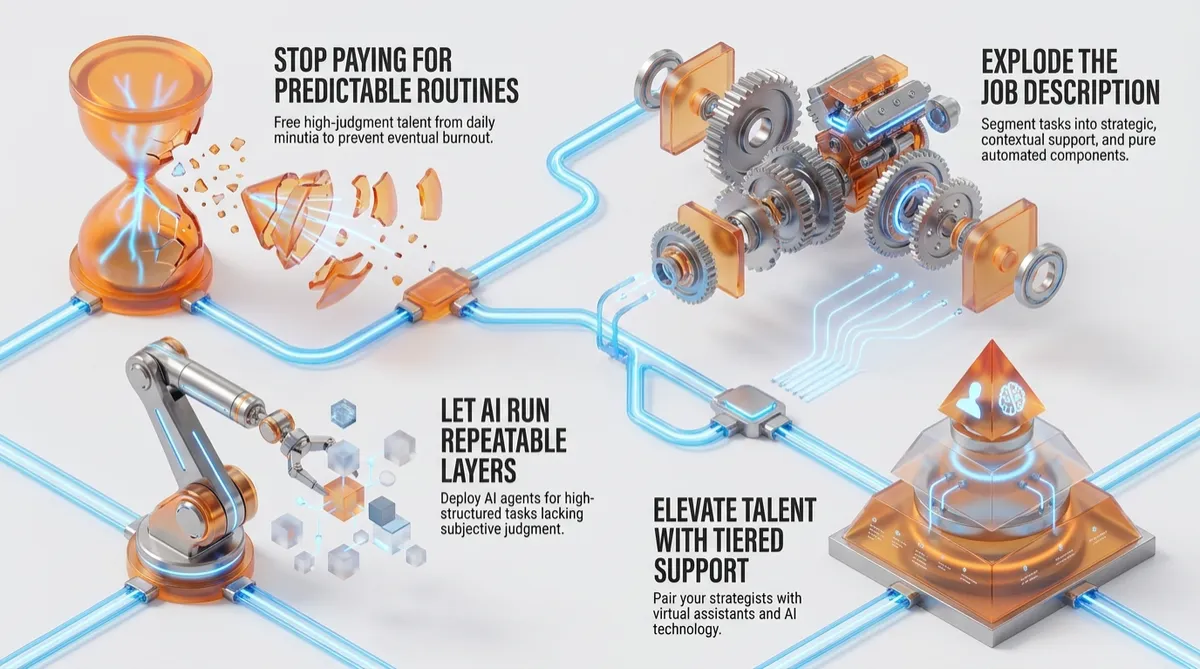
The "Car Part" Deconstruction: Traditional job descriptions are monoliths that trap high-value talent in low-value tasks. AI-leveraged organizations "explode" roles into core components based on the level of human judgment required.
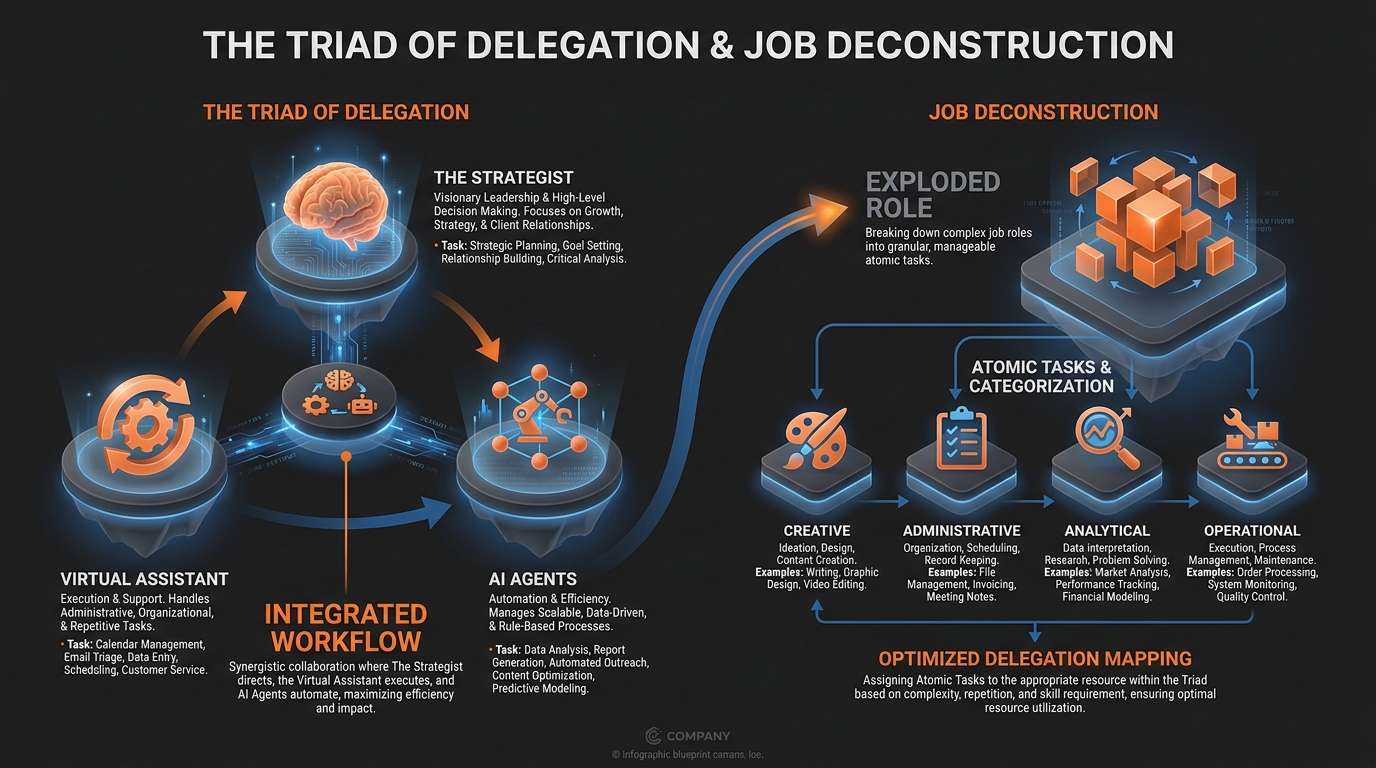
The Judgment Matrix: Work must be segmented into three distinct tiers: Strategic Positioning (Top-Tier Human Talent), Contextual Execution (Virtual Assistants), and Zero-Judgment Repetition (Autonomous AI Agents).
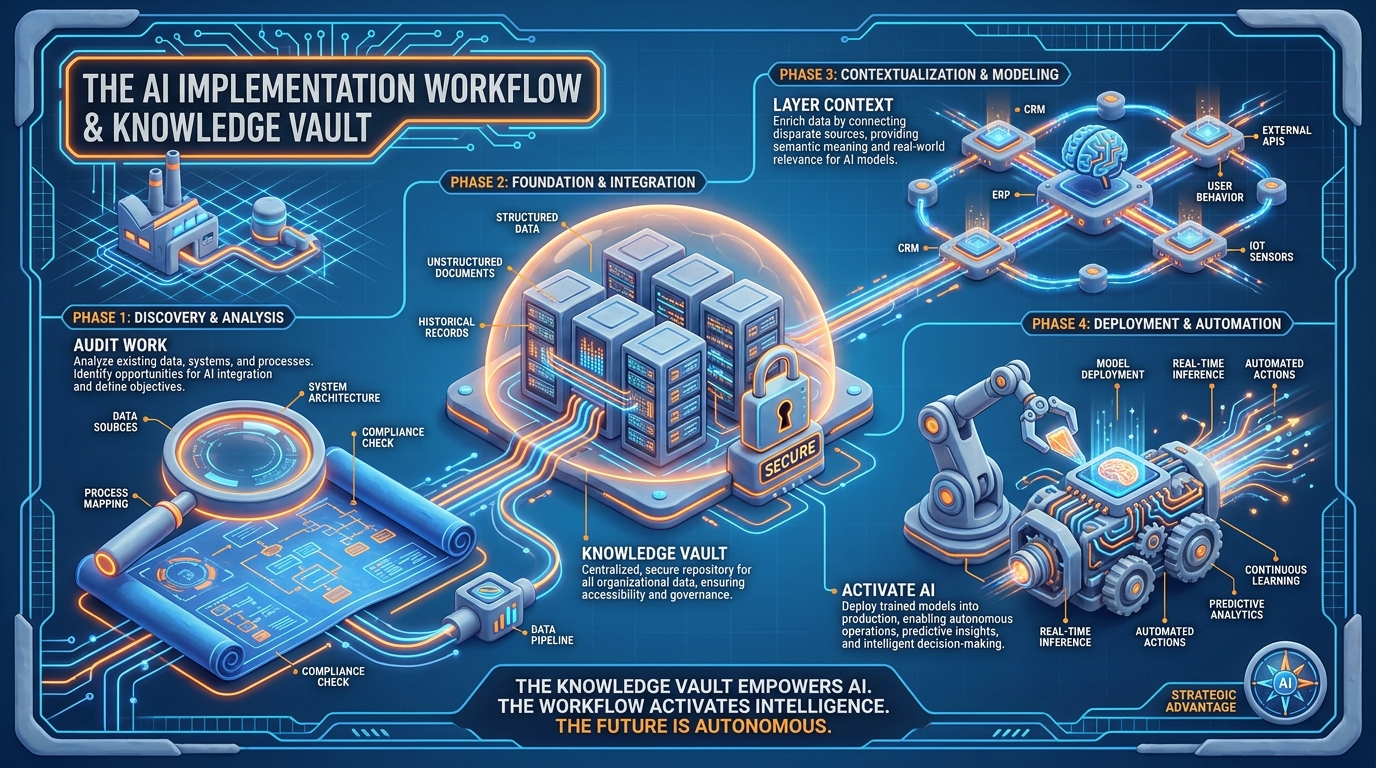
The Knowledge Vault: The foundation of AI integration is centralizing your messy organizational data—meeting notes, manuals, and customer histories—into a secure, queryable AI ecosystem.
Elevation Over Replacement: The goal of AI is not to fire your best people, but to aggressively protect their cognitive bandwidth so they can focus on high-leverage, revenue-generating relationships.
The Strategic Shift
For decades, the standard operating procedure for scaling a business relied on a fundamentally flawed premise: finding a reliable "Captain Do-It-All" and dumping the entire operational load onto their shoulders.
In the old model, business leaders rely heavily on trust. When a complex project lands, you hand it off to your most tenured, high-value employee because you know they will simply figure it out. They know the backstories, they understand the client politics, and they possess the battle scars necessary to navigate tough negotiations. But because they are the point of contact, they also absorb the entirety of the project’s administrative wake.
According to Steve ROI Brown, this is the most common and expensive operational bottleneck in modern business.
When you force your high-level strategists to document notes into a CRM, schedule follow-up meetings, draft routine proposals, and chase internal handoffs, you are effectively paying senior, premium rates for predictable, low-value routines. While your trusted employee can figure out the minutiae, demanding that they do so is an immense waste of their time and your capital.
The immediate result of this legacy model is inefficiency. The long-term result is burnout. You hand off a messy batch of unstructured work to your core people, they spend hours researching and coordinating rather than strategizing, and eventually, they leave. The casualty of this burnout inevitably bubbles right back up to the founder or executive.
Steve ROI Brown’s alternative is a radical structural shift. Instead of hiring people to fill static, monolithic job descriptions, modern organizations must deconstruct work based on the exact level of human judgment required. By segmenting tasks into strategic, contextual, and automated layers, companies can reserve their most expensive human capital strictly for the moments that move the financial needle.
The Core Philosophy
To survive the incoming economic wave, leaders must fundamentally change how they view a "job." You can no longer look at a role as a single, unified checklist assigned to one human being.
Instead, Steve's approach to organizational design requires you to look at a job description the way a mechanic looks at a car part. When you look at an alternator, you don't just see one solid piece of metal; you see a housing, a stator, a rotor, and bearings. You can "explode" that part to see all of its micro-components.
Job descriptions must be exploded in the exact same way. When you blow up a role into its core components, you instantly realize that 80% of the daily workflow requires zero subjective judgment.
"Put judgment where judgment pays, and let AI carry the weight of the routine. You must reserve your high-value talent for the moments that require backstory, political nuance, and the ability to read the room—things artificial intelligence can never realistically discern." — Steve ROI Brown
This mental shift introduces Steve’s proprietary "Triad of Delegation," modeled perfectly by the Batman universe.
The Strategist (Batman): Your high-value employee. They only step in to face the hardest challenges, repair relationships, and close deals.
The Virtual Assistant (Robin): The contextual partner who preps the materials, moves administrative barriers, and ensures the Strategist is set up for success.
The AI and Tech Stack (Alfred): The invisible infrastructure running the repeatable automation, monitoring transcripts, and handling data routing with zero subjective judgment.
When you adopt this philosophy, you realize that true operational efficiency is never about replacing your best people with machines. It is about elevating your talent. It’s about building a customized toolbelt around your top performers so they can walk into a room completely prepared, hit a home run, and move on to the next high-ROI opportunity without getting bogged down in the paperwork.
The Implementation Blueprint
To successfully execute this operational upgrade, you must systematically tear down your existing workflows and rebuild them through the lens of AI leverage. This requires a ruthless assessment of where your payroll is actually going.
Step 1: Exploding the Role and Auditing for Judgment
The first step is to take your most critical job description and literally break it apart. You must separate the tasks that require high-level human intuition from the tasks that are purely administrative or data-driven.
Your high-value talent should only be deployed on tasks that demand "judgment." Judgment includes understanding the origin of a client account, knowing which internal stakeholder can influence a key decision maker, navigating tough conversations, and running formal Quarterly Business Reviews (QBRs). You cannot expect AI to read a room or understand the unspoken politics of a fragile corporate relationship.
The Action: Map out every single touchpoint a senior employee handles in a given week. Highlight the tasks that require high emotional intelligence, relationship building, and strategic positioning in green. Highlight everything else (CRM updates, meeting scheduling, data entry, email follow-ups) in red.
The Business ROI: Immediate salary arbitrage. By identifying the "red" tasks, you expose exactly where you are bleeding capital. As Steve ROI Brown notes:
"Stop paying senior rates for predictable routines. Why are you paying senior salaries for work AI can do?" — Steve ROI Brown
Step 2: Building the "Knowledge Vault"
Artificial intelligence is only as powerful as the context it is given. If your business operates on messy, siloed data spread across different hard drives, email inboxes, and employee memories, your AI tools will hallucinate or fail.
Before you can automate the routine, you must establish a centralized "Knowledge Vault." This is a walled-garden repository where all of your organizational data lives: messy meeting notes, product manuals, legacy job descriptions, customer service FAQs, and website data.
The Action: Aggregate your company's intellectual property and standard operating procedures into a secure, centralized database that AI agents (like Gemini or Grokbot) can query against.
The Business ROI: Enterprise-grade AI accuracy and IP protection. When your AI refers exclusively to your Knowledge Vault, you create a massive competitive moat.
"The gold of our day is the data that flows through your organization. If you can capture it and put it into your knowledge vault, guess what your AI tools are referring to? It's a major lever most of your competitors are not even considering." — Steve ROI Brown
Step 3: Layering Contextual Execution (The "Robin" Layer)
Once you have separated the high-judgment tasks and centralized your data, you must build a bridge between your top-tier talent and your AI tools. This is where a highly trained Virtual Assistant (VA) comes into play.
A VA does not need to know the deep politics of an account, nor should they be put in front of a client for a high-stakes negotiation. However, they possess the necessary human context to manage handoffs, chase deliverables across time zones, and package raw AI outputs into polished templates for your senior team.
The Action: Delegate the "first draft" reviews, meeting coordination, and cross-department handoffs to a dedicated VA. Empower them to act as the handler for the AI agents, ensuring that all prep work is perfectly staged before the senior employee ever looks at it.
The Business ROI: Massively accelerated speed-to-market. Your top performers no longer start from scratch; they start from the 80% completion line, effectively doubling their capacity for client face-time.
Step 4: Activating Autonomous AI Agents (The "Alfred" Layer)
The final layer of the blueprint is fully automating the highly structured, frequently occurring tasks that carry zero subjective judgment. These are tasks that are costly when delayed but require absolutely no human nuance to execute.
Modern autonomous agents, like Grokbot and Google's Gemini Notebook, can monitor key performance indicators in real-time, process raw dialogue from client calls, and trigger automated workflows without a human lifting a finger.
The Action: Connect your meeting intelligence tools to your AI notebooks. Program the AI to scan call transcripts, identify actionable commitments made during the meeting, and automatically route those action items into your project management software (like ClickUp).
The Business ROI: Flawless operational memory and zero-delay execution.
"Drafting immediate follow-up emails, immediate plans, handoffs, or instructions—these are amazing, powerful, exciting things that you can be delegating… put judgment where judgment pays and let AI carry the weight of the routine." — Steve ROI Brown
See These AI Workflows in Action
Understanding how to deconstruct job descriptions and let AI handle routine tasks is one thing. Seeing the technology in action is another. In the latest episode of AI Made Simple, Steve ROI Brown shows how AI can take raw client call transcripts, extract committed tasks, and route those deliverables into ClickUp using Gemini Notebook and Grokbot. You'll see how this approach helps free your top performers from administrative work, protect them from burnout, and give them more time to focus on high-value relationships and strategic decisions.
As business demand grows, you simply cannot scale human effort linearly to meet exponential demand. The organizations that win will be the ones that build smarter systems, reserve human judgment for where it truly pays, and let AI carry the weight of the routine.
Watch the latest AI Made Simple episode on YouTube to see Steve break down these workflows in depth and learn how to build a smarter system that elevates your best people and helps your business scale.
Ready to Make AI Work Better for Your Team?
You don't have to figure out AI on your own. Whether you want to streamline daily operations, free your best people from repetitive tasks, or find new ways to help your business grow, Steve Brown can help you identify the right opportunities and build a practical plan for your team.
Set up a Strategy or Clarity Session with Steve to explore how AI can help your team work smarter, save time, and focus on the work that matters most. Let's make AI simple for your team and turn its potential into real results.