
Bot-to-Bot Economy: Capture 136M New Buyers
Executive Summary
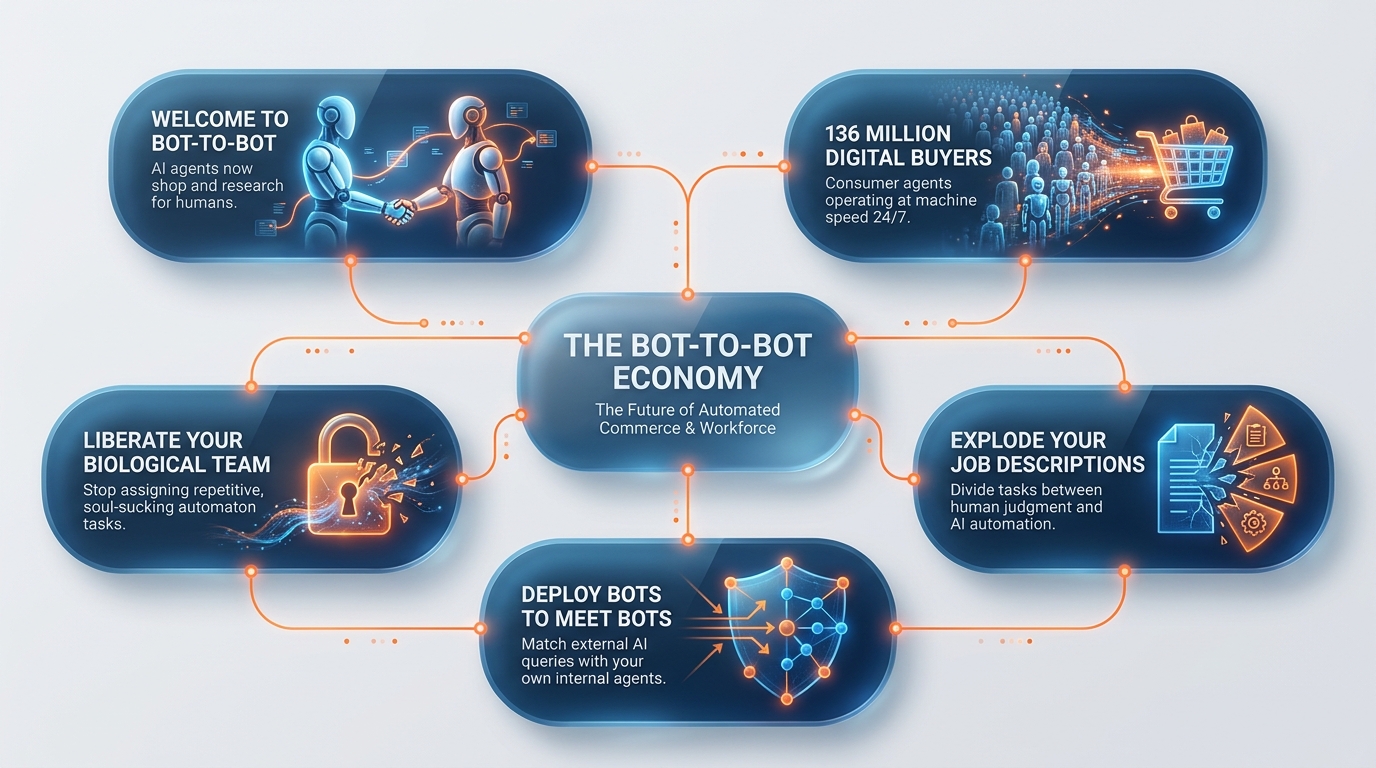
The Death of B2B, The Rise of Bot-to-Bot: Traditional B2B and B2C models are being replaced by agentic interactions. Consumer agents are now actively scraping, evaluating, and purchasing from your website on behalf of human decision-makers.
The 136 Million Buyer TAM Expansion: With approximately 13.6 million early AI adopters deploying an average of 10 autonomous agents each, a shadow market of 136 million digital buyers has instantly materialized, operating 24/7 at machine speed.
Exploding the Job Description: To survive, businesses must dismantle existing roles into three distinct layers: human judgment (high-value), virtual assistant delegation (process-driven), and AI automation (instant execution).
The Drone Defense Strategy: Forcing biological employees to handle inbound inquiries from tireless AI agents is a losing battle. High-ROI businesses are deploying their own AI gatekeepers to negotiate, verify scope, and finalize pricing in milliseconds.
The Strategic Shift
For the last two decades, digital business has been predicated on human-to-human or human-to-machine interactions. You ran ads, a human prospect clicked them, a human evaluated your website, and a human pulled out their credit card. That era is over.
According to Steve ROI Brown, the new reality is fundamentally different. Embodied and digital robots are writing software, driving cars, and—most importantly for your bottom line—shopping for solutions. We are undergoing a massive transition into the "Bot-to-Bot Economy," where consumer AI agents are tasked with making purchasing decisions on behalf of their human operators.
The Old Way: Biological Bottlenecks and Manual Consideration
In the legacy model, a prospect tasked with finding a corporate hotel in El Salvador would spend three evenings manually comparing rates, amenities, and locations before making a booking. Because this prospect was human, your business could rely on flashy marketing copy, emotional appeals, and aggressive retargeting to win the deal.
Internally, you relied on "automatons"—biological employees forced to do robotic, repetitive, soul-sucking work. They manually answered emails, scheduled appointments, and processed data entry. This human processing operates at a biological speed, limited by working hours, fatigue, emotional capacity, and family responsibilities.
The High-ROI Alternative: Thriving in the Consumer Agent Economy
In the modern landscape, that same prospect no longer browses your site. Instead, they open a consumer agent tool like Muse or Grokbot, input their travel dates and preferences, and walk away. The AI agent immediately scours the web, evaluates dozens of options, shortlists the top three based strictly on data, and even completes the credit card transaction automatically.
Hours of human time have been reclaimed. But for your business, this means your marketing is now being evaluated by an emotionless machine in a matter of milliseconds. Steve points out a staggering market reality: roughly 4% of the U.S. population (about 13.6 million people) are paying for advanced AI models. If each of those power users deploys just 10 digital agents to handle their daily research, shopping, and scheduling, you are suddenly looking at a Total Addressable Market (TAM) of 136 million new digital buyers.
These representatives don't sleep. They don't get distracted. To capture this unprecedented volume of digital buyers, you must shift away from human-led data processing and transition entirely to AI-to-AI processing.
The Core Philosophy
To capture market share in this new reality, you must undergo a complete mental shift in how you view your digital storefront and your operational structure. Steve ROI Brown refers to this as the "Refrigerator Framework."
When an AI bot peruses your website, it acts as an investigator. It has been given strict permissions by its human boss to research, evaluate, and bring back a viable solution. It does not care about your website's aesthetics. It is looking for machine-readable clarity, transparent pricing, and defined deliverables. If your business requires a human to "hop on a discovery call" just to get basic scope and pricing, the AI agent will instantly cut you from the consideration list.
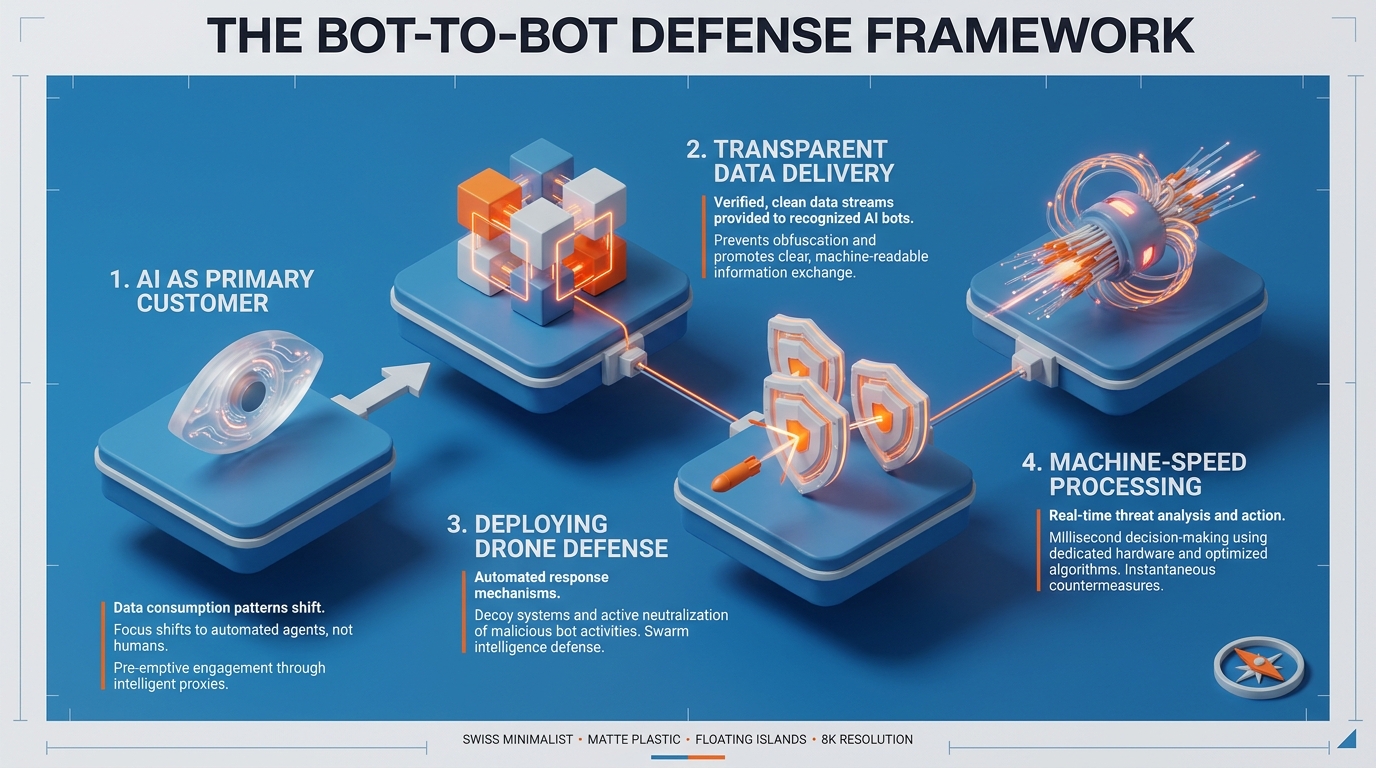
To win, you must stop treating AI as a novelty and start treating it as your primary customer and your primary defense mechanism.
"You don't need a computer science degree. You just need to know that your job is to create clarity and proper expectations and give the robot, your artificial intelligence, the proper expectations, and let it do all the details. We're moving from B2B to Bot-to-Bot." — Steve ROI Brown
The standalone "Aha!" moment here is recognizing the asymmetry of modern digital warfare. If your external customers are using AI drones to scrape your business, and you are using human employees to manually field those automated queries, you will be crushed by the volume. You must deploy your own bots to talk to their bots. You must establish a system where machines handle the minutia so your biological team can focus entirely on high-level strategy, empathy, and final judgment.
The Implementation Blueprint
Adapting to the Bot-to-Bot economy requires a structural tear-down of how you allocate human capital. Steve's approach ensures that you don't just survive the influx of automated buyers, but actively increase your operational ROI by delegating repetitive tasks to infinite-capacity agents.
1. Explode the Job Description
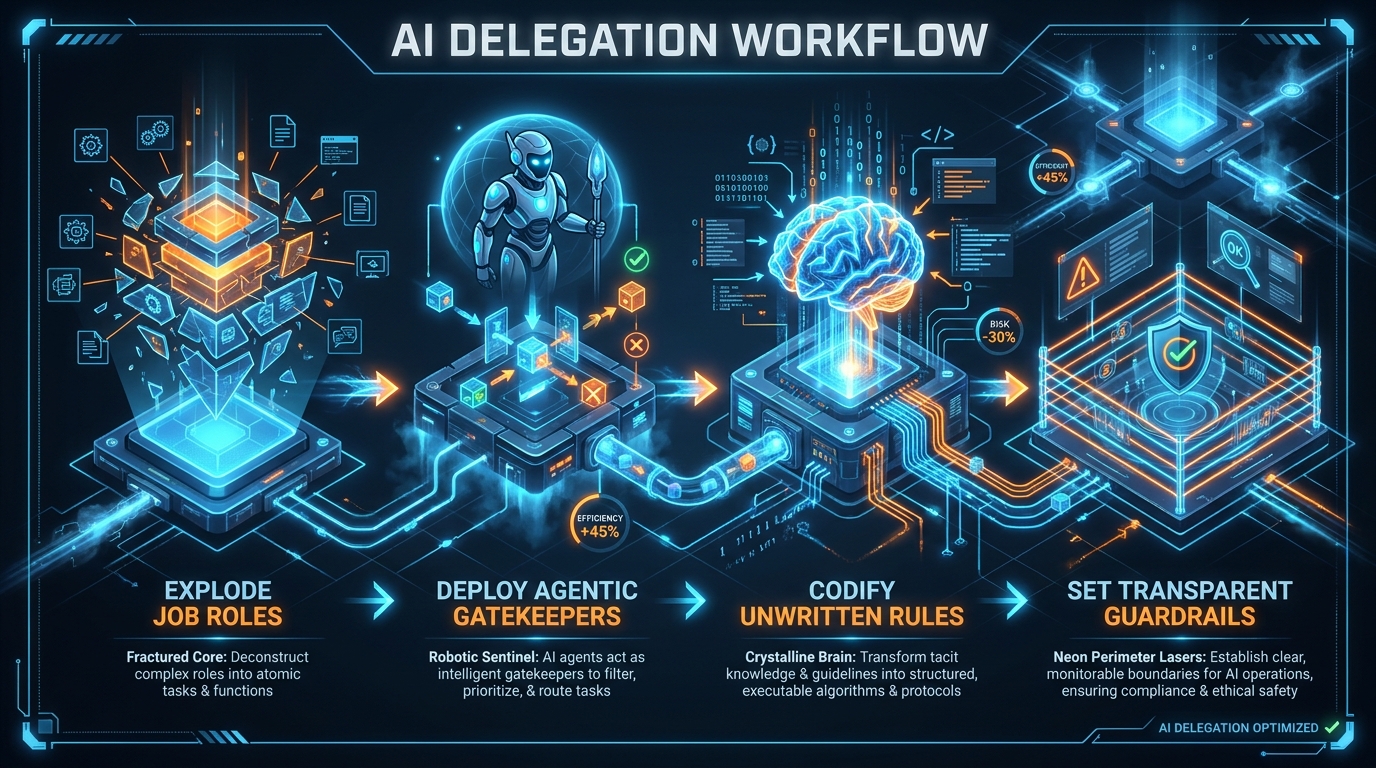
The Action: You must stop handing monolithic job descriptions to human employees. Instead, audit every role in your company and "explode" the job description into three distinct layers. First, isolate the tasks that require deep human judgment, political understanding, and contextual backstory. Second, identify the repetitive but slightly nuanced tasks that can be delegated to a remote Virtual Assistant (VA). Third, isolate the purely data-driven, administrative, and scheduling tasks that can be completely handed over to an AI agent.
The Business ROI: By fracturing your job descriptions, you instantly reclaim massive amounts of high-value human capital. You stop paying premium biological salaries for data entry and scheduling. This liberates your team to focus on revenue-generating activities while the AI handles the administrative bloat at zero marginal cost.
"[We] expect humans to do a bunch of robotic work, repetitive work, soul sucking work. And that's called an automaton. It's almost an insult. But we do a version of that when we expect our team to do a bunch of minutia." — Steve ROI Brown
2. Deploy Agentic Gatekeepers
The Action: Stop expecting your human staff to reply to endless inbound digital queries, especially when those queries are increasingly being generated by consumer bots. You must deploy your own AI agents, trained on your specific business rules, pricing, and scope, to act as the first line of communication. When a buyer's bot reaches out to evaluate your company, your internal bot should immediately engage it, verify the scope, and negotiate terms in milliseconds.
The Business ROI: Millisecond response times and 24/7 availability. In a landscape where consumer bots are generating infinite repetitive queries, human response times (which take days or hours) will cost you deals. By fighting fire with fire, your business operates at machine speed, ensuring you never miss a consideration phase just because your staff was off the clock.
"Don't send your team out to deal with the drones. Get your drones in action to represent your business and conduct business in this new reality." — Steve ROI Brown
3. Codify the Unwritten Rules
The Action: Your company currently operates on the hidden operational genius locked inside your brain and the brains of your key leadership. AI cannot optimize what it cannot understand. You must sit down with an LLM (like Gemini or Claude) and do a complete brain dump. State your intent, establish what you want, heavily emphasize what you do not want, and let the AI codify your unwritten rules into a concrete, machine-readable standard operating procedure (SOP).
The Business ROI: You achieve flawless systemization without needing to hire an expensive operations consultant or possess a computer science degree. Once your internal rules are clearly defined and dumped into an AI, your agentic bots can take over optimization, ensuring that every automated interaction perfectly aligns with your founder-level expectations.
"Take all this operational genius from your biological hard drive your brain and untangle your unwritten rules and dump it in and all of a sudden now you're codifying, you're creating a system of great clarity…" — Steve ROI Brown
4. Establish Transparent Guardrails for AI Buyers
The Action: Restructure your public-facing assets to be seamlessly consumable by AI. This means transparent pricing models, explicitly defined deliverables, and clear scoping parameters. Remove the friction of hidden pricing tiers and gated information that requires human intervention to unlock.
The Business ROI: You guarantee your inclusion in the AI buyer's shortlist. When an external AI is tasked with finding three vendors, it will naturally bypass the vendor with opaque pricing in favor of the vendor whose data is instantly verifiable. By providing transparent deliverables, you position your business as a high-authority, frictionless option for the 136 million AI agents actively shopping the web.
See the Bot-to-Bot Economy in Action
Understanding the theory of the Bot-to-Bot economy is only half the battle; execution is where the ROI is realized. The accompanying AI Made Simple episode serves as Steve ROI Brown's deep dive into this exact framework.
During the session, Steve visualizes the exact workflow of taking a standard, outdated job description, walking it directly into a tool like Gemini Notebook, and engineering a highly specific prompt. He demonstrates the real-time back-and-forth negotiation with the LLM—inputting intent, establishing strict boundaries, and forcing the AI to generate a three-tiered delegation plan. By watching the live workflow, you can see exactly how to extract the "operational genius" from a biological hard drive and transform it into a delegatable, machine-ready action plan in a matter of minutes.
The transition from biological business to the Bot-to-Bot economy is not a distant future state; it is a present reality. There are already over 136 million digital proxies out in the wild, armed with instructions from human decision-makers, actively vetting businesses just like yours. The leaders who adopt this operational shift today, by exploding their job descriptions, creating operational clarity, and deploying their own agents to interface with the market, will unlock unprecedented scale and dramatically lower their cost of acquisition.
Watch the latest AI Made Simple episode on YouTube to see Steve discuss the Bot-to-Bot economy in depth and show exactly how to build these delegation frameworks and codify your unwritten rules in real time.
Ready to Help Your Team Win in the Bot-to-Bot Economy?
You have a massive new addressable market waiting for you. It's time to structure your business for machine-speed transactions. You've got this—you just need a plan.
If your team is still fielding every inquiry by hand or buried in robotic work that AI could handle, it may be time to build that plan. Set up a Strategy or Clarity Session with Steve ROI Brown to find where AI agents, automation, and the right human support can help your team work smarter and move faster.
We'll help you make sense of the technology and put AI to work so your people, and your business, get better.