The Clear Vision Workflow: Drive High-ROI AI Alignment
How to Eliminate Organizational Friction and Drive High-ROI Alignment with AI
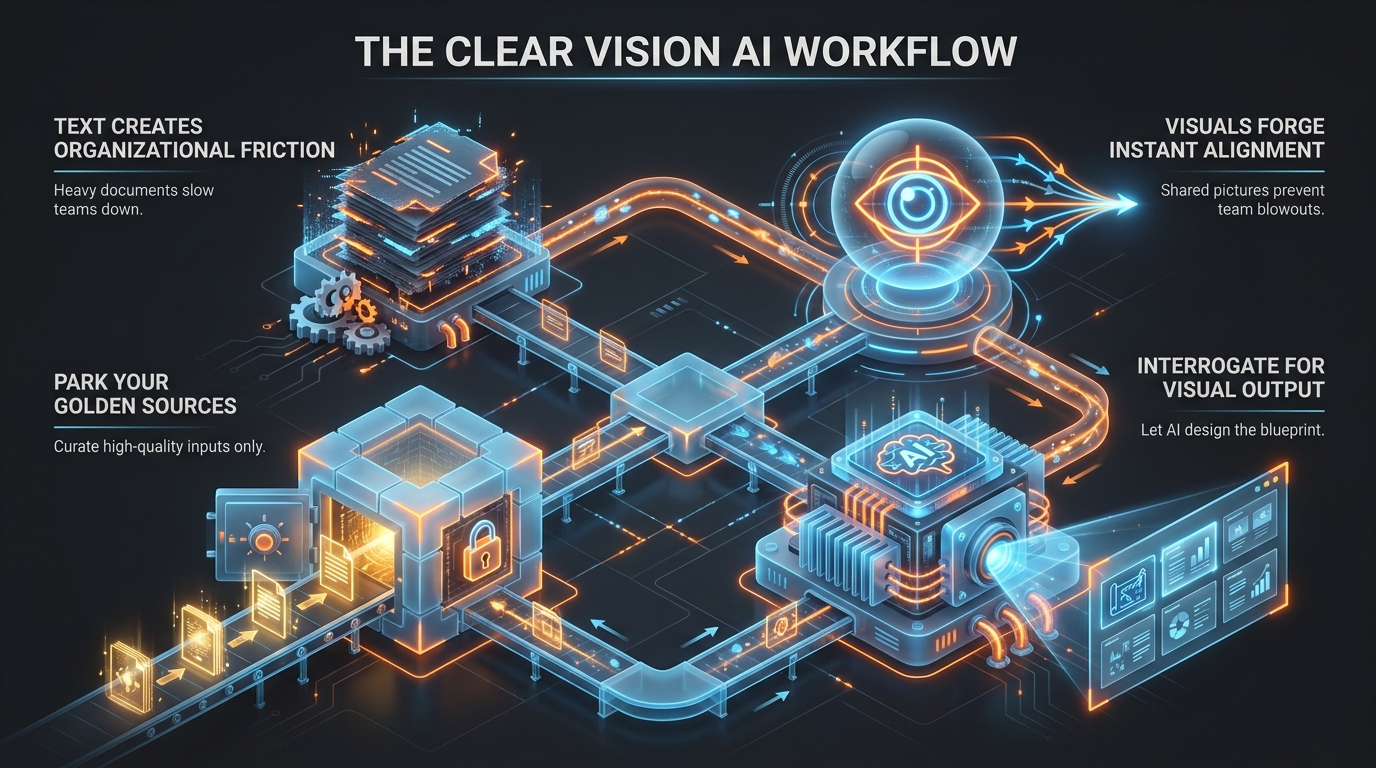
Visuals Over Analog Text: Relying on heavy text to communicate strategy creates operational friction. Shifting to visual communication acts as a "fiber-optic" upgrade for your team's comprehension and execution speed.
The "Closed-Box" AI Strategy: Utilizing tools like NotebookLM as a closed system—where you only feed it vetted, high-value resources—eliminates hallucinations and guarantees high-fidelity, actionable outputs ("Gold in, gold out").
Preventing Organizational Blowouts: Misalignment at scale operates like a misaligned tire on a fast-moving vehicle. By visually mapping the aspirational future, leadership can instantly eliminate the operational "wobble" that leads to employee turnover, client friction, and lost revenue.
Group Effervescence via Visual Alignment: Bypassing individual biases by presenting a unified, AI-generated visual endpoint forces diverse teams to row toward the exact same point on the horizon, creating a massive competitive advantage.
The Strategic Shift
The Trap of the "Eighth-Grade Level" Default
In corporate environments, the standard operating procedure for transferring knowledge is to write a document. We spend at least twelve years in the education system learning how to read, write, format theses, and communicate concepts strictly through text. As a result, when a leader needs to roll out a new strategic initiative, their default behavior is to lock themselves in a room and write a dense, comprehensive plan.
But there is a fatal flaw in this approach: reading text is a high-friction activity. We assume our teams, prospects, and stakeholders have high reading comprehension, the time to digest fifty pages of strategy, and the patience to decode our intent. They don't. This is precisely why marketing dogma insists that content must be written at an "eighth-grade reading level."
According to Steve ROI Brown, forcing brilliant, complex business solutions into dumbed-down text fundamentally limits the velocity of a business. If it was painful for the leader to write the document, it is exponentially more painful for the team to read and execute it.
Analog Friction vs. Fiber-Optic Speed
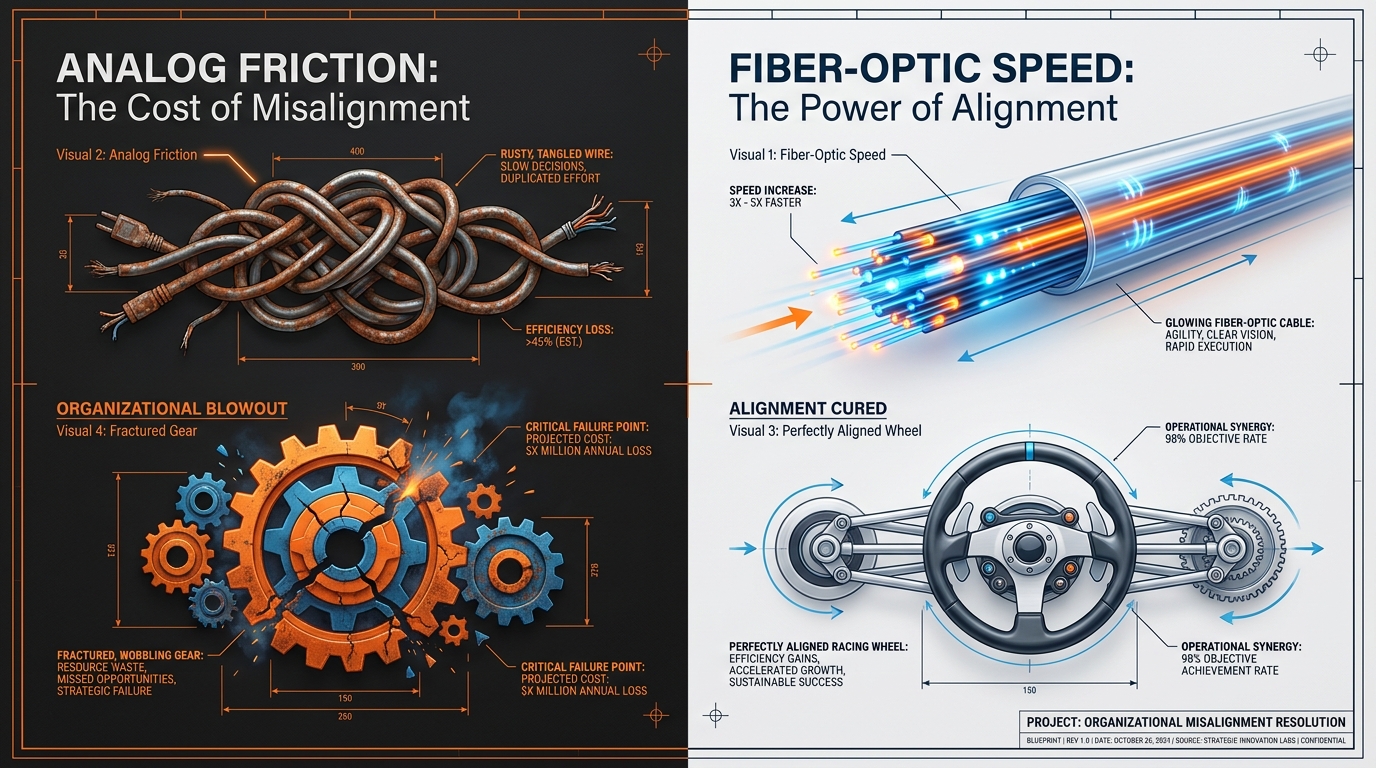
Relying on text to build organizational alignment is the equivalent of trying to stream high-definition video over a 1990s dial-up AOL connection. It is slow, it is noisy, and data gets lost in translation. Every single team member reading a text document will interpret the words through their own unique biases, experiences, and departmental lenses.
Visuals, on the other hand, are first principles communication. They are fiber-optic. A single, well-designed visual depicting the desired end-state bypasses the cognitive load of reading and instantly maps the concept directly into the viewer's brain. To win in today's landscape—whether you are closing a million-dollar VIP client or aligning a globally distributed workforce—you must shift from the analog friction of text to the instantaneous clarity of visual alignment.
The Core Philosophy
To achieve true scale, leaders must recognize that organizational alignment is never an accident. The teams that consistently dominate their markets all share one fundamental trait: they are aggressively rowing toward the exact same point on the horizon.
Getting a chaotic, fast-moving organization to see that singular point is the hardest job of leadership. Imagine having the power of telepathy—the ability to take a complex, messy idea from inside your brain and instantly project it into the minds of your executive team, your sales force, and your clients. That is the core philosophy behind Steve ROI Brown's framework.
"Organizations that are out of alignment eventually have blowouts. You've all been a part of something that had a blowout… it wasn't clear where we were going. And that's why the team was out of alignment." — Steve ROI Brown
Think of your company as a high-performance vehicle. If your team is misaligned, it acts like a misaligned tire. At ten miles per hour, you might barely notice the wobble. But as your company picks up speed, momentum, and scale, that misalignment becomes violent. Employees get frustrated and quit. Customers complain. Deals fall through. The organization suffers a catastrophic "blowout."
The mental shift required here is moving from explaining the goal to illustrating the goal. By making the aspirational future visible, you permanently repair the alignment of the vehicle, allowing it to safely handle the speed of rapid growth.
The Implementation Blueprint
To execute this mental shift, Steve ROI Brown developed The Clear Vision Workflow. This framework leverages the unique architecture of Google's NotebookLM to translate disparate, complex textual data into high-ROI visual assets that instantly align teams and close high-stakes deals.
Step 1: Curating High-Signal Intelligence (The "Gold In" Principle)
The Action: The workflow begins by intentionally parking your highest-value resources into a single, closed AI environment. If you are preparing for a high-stakes sales presentation—where hundreds of thousands or millions of dollars are on the line—do not bring a generic pitch deck. Instead, gather the prospect’s website copy, their investment materials, past proposals, and the transcripts of your previous Zoom discovery calls. Combine this with the specific documentation detailing your proprietary solutions.
The Business ROI: By controlling the inputs, you entirely eliminate the risk of AI hallucination. NotebookLM is not scraping the open web for generic noise; it is forced to synthesize only the specific business context you provide. This ensures absolute precision in the output, protecting your brand authority and drastically increasing your win rate in VIP enterprise deals.
"Garbage in, garbage out. Gold in, gold out." — Steve ROI Brown
Step 2: The Closed-Box AI Interrogation
The Action: Once your golden resources are parked in the system, you treat the AI not as a search engine, but as an elite, in-house team of analysts and storytellers. You must aggressively interrogate the data. You prompt the system to find the narrative thread connecting the client's pain points to your solution. Command the AI with precise instructions, such as: "Outline exact steps and value-add to create alignment. Base the plan only on the parked documents. Output goal: Write a vision for the outcome that helps the prospect see the aspirational future."
The Business ROI: This step compresses weeks of strategic analysis into seconds. Instead of a leadership team spending countless billable hours trying to synthesize meeting notes and technical documents, the closed-box interrogation instantly surfaces the critical path forward. This allows executives to focus their energy on high-leverage execution rather than low-leverage data sorting.
Step 3: Extracting the Visual Endpoint
The Action: With the strategy outlined, you must now convert the analog text into a fiber-optic visual. Command the AI to extract specific, punchy insights that paint a picture. Instruct it to: "Make a list of the best one-liners from this source. The ones that land the point by drawing a picture in the mind of the listener." Once the system generates these high-impact statements, seamlessly convert them into an actionable format, such as a slide deck, an infographic, or a mind map directly within the AI interface.
The Business ROI: This is where friction dies. When you walk into a boardroom with a visually mapped outcome, you bypass the cognitive resistance of your audience. They don't have to read between the lines; they just have to look at the destination. This accelerates decision-making processes and significantly reduces sales cycles.
"When you make the aspirational future visible, you eliminate friction." — Steve ROI Brown
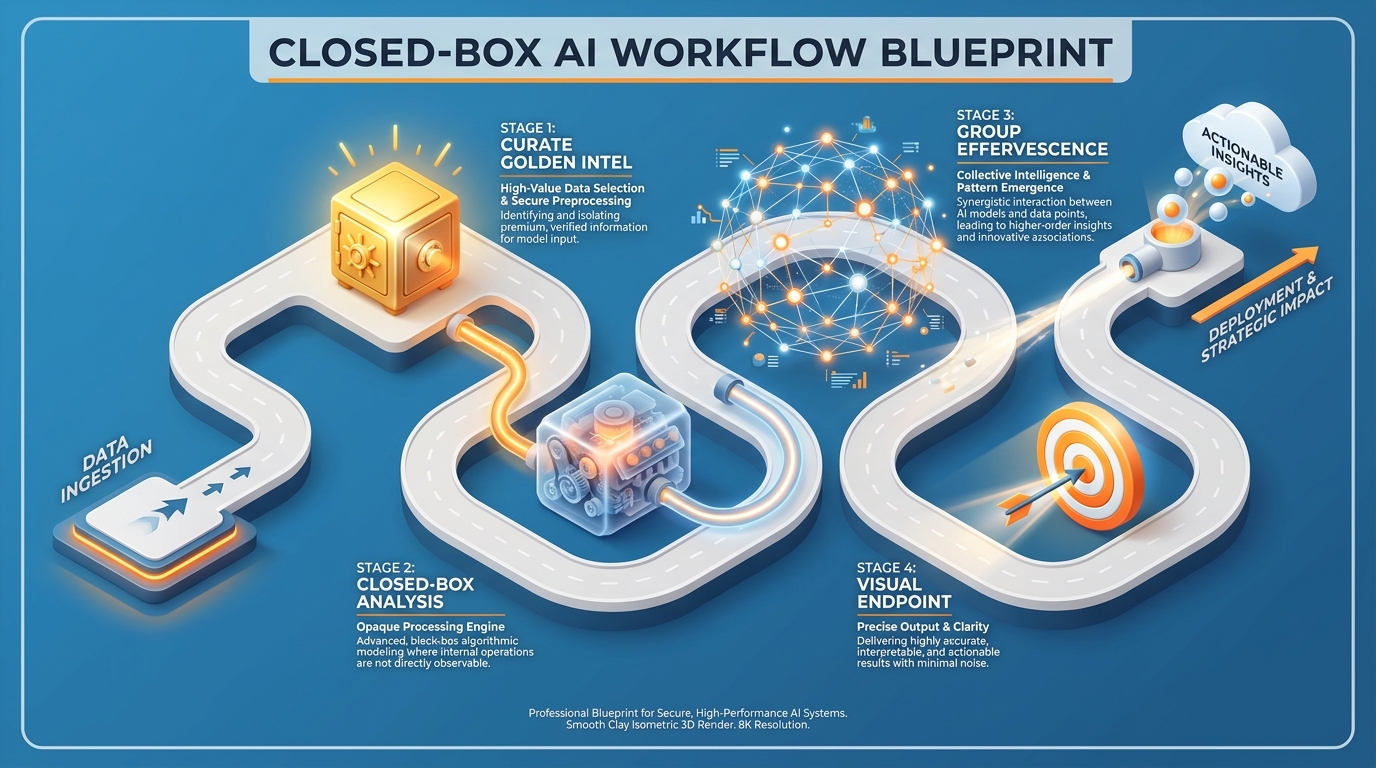
Step 4: Forging Group Effervescence
The Action: Present the newly minted visual asset to your team or prospect. Because a visual is objective, it creates a shared, instant understanding of the end goal. It prevents the typical meeting dynamic where five different department heads critique a written plan based on their own isolated biases and departmental agendas.
The Business ROI: This step triggers what is known as "group effervescence"—a powerful psychological state of collective alignment. When every individual in the room can clearly see the exact same point on the horizon, cross-functional collaboration skyrockets. The "wobble" in your organizational tire is eliminated, reducing costly employee turnover, streamlining operations, and directly improving the bottom-line profitability of your company.
The Strategic Takeaway
Relying on text-heavy communication is a hidden tax on your organization. It forces your team to slow down, breeds individual misinterpretations, and creates the operational wobble that eventually leads to costly organizational blowouts.
By adopting the Clear Vision Workflow, you shift your leadership from analog to fiber-optic. Using a closed-box AI system like NotebookLM to transform trusted, high-value information into visual assets creates instant clarity, stronger alignment, and faster decision-making. Instead of hoping everyone interprets a document the same way, you give your team a shared vision they can immediately understand and execute.
If you want to see this workflow in action, watch the full episode of AI Made Simple on YouTube. Steve walks through the entire process live—from loading source material into NotebookLM to extracting powerful one-liners and turning them into presentation-ready visual assets in just minutes. Seeing the workflow unfold step by step makes it much easier to understand how you can apply the same approach to align your team, communicate more effectively, and eliminate friction across your organization.
Ready to Bring This Level of Clarity to Your Team?
Reading about these strategies is a great first step. Applying them to your business is where the real transformation happens.
If your team is struggling with scattered communication, unclear messaging, or getting everyone aligned around the same vision, Steve can help. In a personalized Strategy & Clarity Session, he'll work with you to identify the friction slowing your business down and show you how AI can simplify communication, strengthen alignment, and help your team operate with greater confidence and focus.
Whether you're leading a small business, a marketing agency, a nonprofit, or a growing sales team, the goal is the same: use AI as a practical tool to help your people work smarter—not harder.
If you're ready to build a more aligned, more effective organization, schedule a Strategy & Clarity Session with Steve today. Together, you'll create a roadmap for using AI to amplify your team's strengths and accelerate meaningful results.