
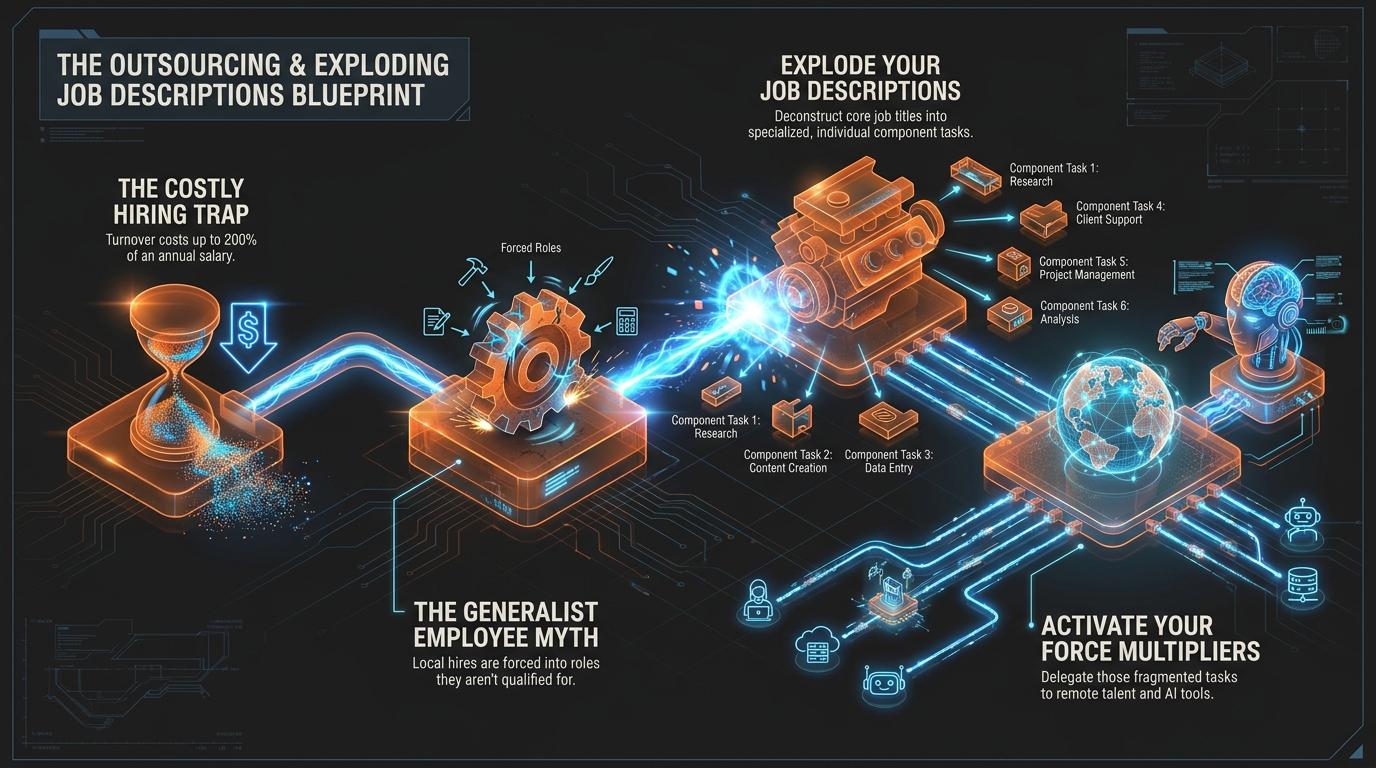
Exploded Diagram: Escaping the Hiring Trap
Surviving the Hiring Trap and Scaling with Global Force Multipliers
The 200% Replacement Penalty: The traditional model of replacing a lost employee costs between 50% and 200% of their annual salary in lost productivity, onboarding, and training—a catastrophic hit to the runway of a growing business.
The "Exploded Diagram" Framework: Instead of hiring local generalists to fill monolithic job titles, high-ROI organizations "explode" job descriptions into micro-components, isolating high-value strategic tasks from repetitive operational drains.
The Global Force Multiplier: By delegating operational micro-components to elite remote teams (e.g., in the Philippines or South Africa) and AI agents, businesses can scale their output without inflating domestic payroll overhead.
Protecting Core Talent: Radically reallocating tasks via the Exploded Diagram prevents burnout among loyal, high-performing internal team members, allowing them to operate exclusively in their zones of genius.
The Strategic Shift: Escaping the Local Generalist Trap
When a business faces a sudden crisis—whether it is a macroeconomic downturn, a global event like the pandemic, or an unexpected wave of employee turnover—the immediate reflex is often survival through consolidation. Remaining team members step up, taking on the offloaded responsibilities of those who departed. They absorb the extra hours, juggle the unfamiliar tasks, and keep the engine running out of sheer loyalty.
But as Steve ROI Brown fundamentally understands, treating emergency consolidation as a long-term operating procedure is a recipe for disaster. Expecting dedicated employees to endlessly perform tasks that drain their energy and fall outside their core competencies leads to inevitable degradation in performance, plummeting morale, and ultimately, a breakdown in customer service.
When the cracks begin to show, the conventional "Status Quo" business owner reaches for the default solution: going to the local market to hire a direct replacement.
This is what Steve refers to as the "Hiring Trap."
The reality of the traditional hiring model is deeply flawed and heavily stacked against the small-to-medium business owner. Bringing on a local generalist means committing to a massive capital outlay. According to Steve ROI Brown’s analysis of labor data, replacing a single employee typically drains between 50% and 200% of their annual salary. This hidden tax comes in the form of recruitment costs, interview hours, extended onboarding periods, and the inevitable six-month ramp-up time before that new hire begins pulling their own weight.
Furthermore, small businesses simply cannot afford to "kiss a couple of frogs." A mis-hire in this traditional model consumes vital runway. If you hire someone who isn't the perfect fit, you are forced to start the expensive, six-month cycle all over again, bleeding cash while your core team continues to burn out.
The modern, high-ROI alternative requires a radical departure from this monolithic hiring mindset. Instead of searching for expensive, local generalists to adopt a bloated list of disparate responsibilities, modern businesses must learn to deconstruct the very concept of the job description itself.
The Core Philosophy: The Exploded Diagram
To survive constrained resources and avoid the 200% replacement penalty, a total mental shift is required regarding how work is categorized, assigned, and executed.
Think of a complex mechanical component, like a carburetor or a water pump in an engine. If you look up that part in a service manual, you don't just see a picture of the solid block of metal. You see an exploded diagram. You see the schematics illustrating how dozens of individual springs, gaskets, valves, and bolts come together to create the whole component.
According to Steve ROI Brown, this is exactly how you must view a job title in your company.
"Your job descriptions are the same way. If you exploded them and looked at all the pieces going on… you have your email management, data entry, scheduling, research, strategy, planning, client calls. You have all these things that are going on. If you do the default solution of hiring a person, you’re expecting that person to adopt all of these components… they're not a specialist necessarily, they become a generalist. And then it's just expensive." — Steve ROI Brown
This is the standalone "Aha!" moment for the high-ROI business operator: You do not need to hire a person; you need to execute a series of components.
When you look at a traditional "Marketing Manager" role, you aren't just looking at one job. You are looking at an amalgamation of micro-tasks. You need someone who can write copy, manage social media platforms, leverage AI tooling, conduct client-facing strategy calls, and manage data entry. No single local hire is going to be world-class at all of those things. They might excel at strategy but be terribly inefficient at data entry.

By using the Exploded Diagram philosophy, you stop trying to hire unicorns. Instead, you extract the components that do not require an in-house presence and delegate them to highly specialized, cost-effective global talent or AI systems. This instantly frees your high-value, local employees to focus 100% of their bandwidth on the high-yield tasks where they actually flourish.
The Implementation Blueprint: Architecting the Force Multiplier
Transforming your organizational structure through the Exploded Diagram is not a theoretical exercise; it requires a systematic, step-by-step implementation. This blueprint outlines how to deconstruct your operations, isolate inefficiencies, and deploy high-leverage assets to multiply your business's output.
Step 1: Audit and Explode the Monolithic Role
The Action: Stop looking at job titles and start cataloging actions. Sit down with your current operational workflow and use AI to help you map out every single micro-task that makes up a specific role in your company. Break a title like "Account Manager" down into its atomic parts: inbox triage, CRM updating, client onboarding, strategy development, monthly reporting, and retention calls.
The Business ROI: This exercise provides immediate, granular visibility into where your payroll dollars are actually going. It reveals the invisible bottlenecks in your business and prevents you from making a bloated, generalized hire when you really only need specific operational support.
“If you keep trying to solve your new problems with your old hiring mindset, you're going to run out of resources before you run out of work.” — Steve ROI Brown
Step 2: Isolate Energy Drains vs. Core Strengths
The Action: Once the job description is exploded into its individual components, categorize them. Identify the tasks that require high-level strategic thinking, local cultural context, or face-to-face client interaction. These are the "Core Strengths" to be kept in-house. Then, identify the repetitive, time-consuming administrative duties that drain your local team's energy.
The Business ROI: Protecting your local talent's cognitive load is one of the highest ROI moves a leader can make. By removing the "energy drains," you instantly increase the output, morale, and retention rate of your most expensive domestic employees. They no longer feel bogged down by administrative minutiae; they feel empowered to drive revenue.
“If you exploded them and looked at all the pieces… you have your email management, data entry, scheduling, research… you don't need someone in-house that can do all of the things.” — Steve ROI Brown

Step 3: Deploy AI and Global Force Multipliers
The Action: Take the isolated "energy drain" tasks and route them to your Force Multipliers. First, identify tasks that can be fully automated using AI platforms like Gemini NotebookLM (e.g., data synthesis, rapid research, content formatting). Second, take the remaining operational tasks and assign them to dedicated, highly skilled remote professionals in regions like the Philippines or South Africa.
The Business ROI: This creates an asymmetric advantage for your business. You are acquiring top-tier, specialized talent to handle operational load at a fraction of the cost of a local generalist. You bypass the six-month hiring and training lag, instantly extending your financial runway and increasing your profit margins.
“These are force multipliers. That's how you can extend the capabilities of your existing loyal, dedicated, high-value team.” — Steve ROI Brown
Step 4: Cultivate a Borderless Culture
The Action: Do not treat your global team members as disposable, transactional gig workers. Integrate them deeply into your company culture. Treat them with the exact same respect, inclusion, and long-term vision as your domestic employees. Invest time in building relationships, understanding their strengths, and making them a visible, celebrated part of your brand's client experience.
The Business ROI: Transactional outsourcing leads to high turnover and poor quality control. Cultural integration yields fierce loyalty and world-class performance. Steve's approach to global hiring results in team members who stay for years, driving such immense value that clients actively notice and request the same level of global support for their own businesses. Loyalty breeds consistency, and consistency breeds scalable revenue.

See the Exploded Diagram in Action
Relying on the default model of hiring expensive, local generalists to solve capacity problems is an outdated strategy that chokes cash flow and burns out top performers. In a landscape where speed, efficiency, and capital preservation are paramount, the businesses that thrive are the ones that learn to decouple the work from the job title.
By mastering Steve ROI Brown’s Exploded Diagram framework, you can build a more resilient, agile infrastructure while empowering your domestic team to operate at their absolute peak, supported by global specialists and AI force multipliers executing in the background.
But understanding the idea is one thing. Seeing how it works in the real world is another.
In the latest AI Made Simple episode, Steve ROI Brown breaks down the hidden costs of local hiring, deconstructs job descriptions using the Exploded Diagram framework, and shows how tools like Gemini NotebookLM can work alongside remote teams as a force multiplier. He walks through the data and the workflow so you can see exactly how this approach can help you protect your best people, extend your resources, and scale more efficiently.
Watch the full AI Made Simple episode on YouTube to see the strategy in action and learn how to start building your own force-multiplier team.
Wondering What a Full-Time VA Could Actually Take Off Your Plate?
Steve ROI Brown can help you figure out where a dedicated virtual assistant could make the biggest difference for your team. Set up a quick 15-minute Strategy or Clarity Session to look at your workload, identify what can be delegated or improved with AI, and map out what you could expect from adding the right VA to your team.
You don't have to figure it all out on your own. Let's look at your business, find the opportunities, and build a smarter way for your team to work.