

From Bottleneck to Visionary: How to Turn Your Ideas Into a System Your Team Can Actually Use
Every growing business hits a moment where the leader becomes the center of everything. Every big decision, every important conversation, every final approval. It feels good at first. You are the closer. The one who makes things happen.
But over time, it starts to feel heavy.
You cannot step away. Your team waits on you. Deals depend on you being in the room. And deep down, you know this is not real growth. It is just a high pressure job with a business wrapped around it.
Here is the truth. If your ideas only live in your head, your team cannot execute them well. And when your team cannot execute, you stay stuck.
Before we go deeper, this idea is also explored in the AI Made Simple podcast. You can find it on YouTube if you want to see how AI helps leaders communicate clearly and lead with confidence.
The Real Problem: The “Knack Gap”
Many leaders have something powerful. A unique way of solving problems. A method that works. A perspective that delivers results.
But there is a gap.
That gap is between what you know and what your team can explain.
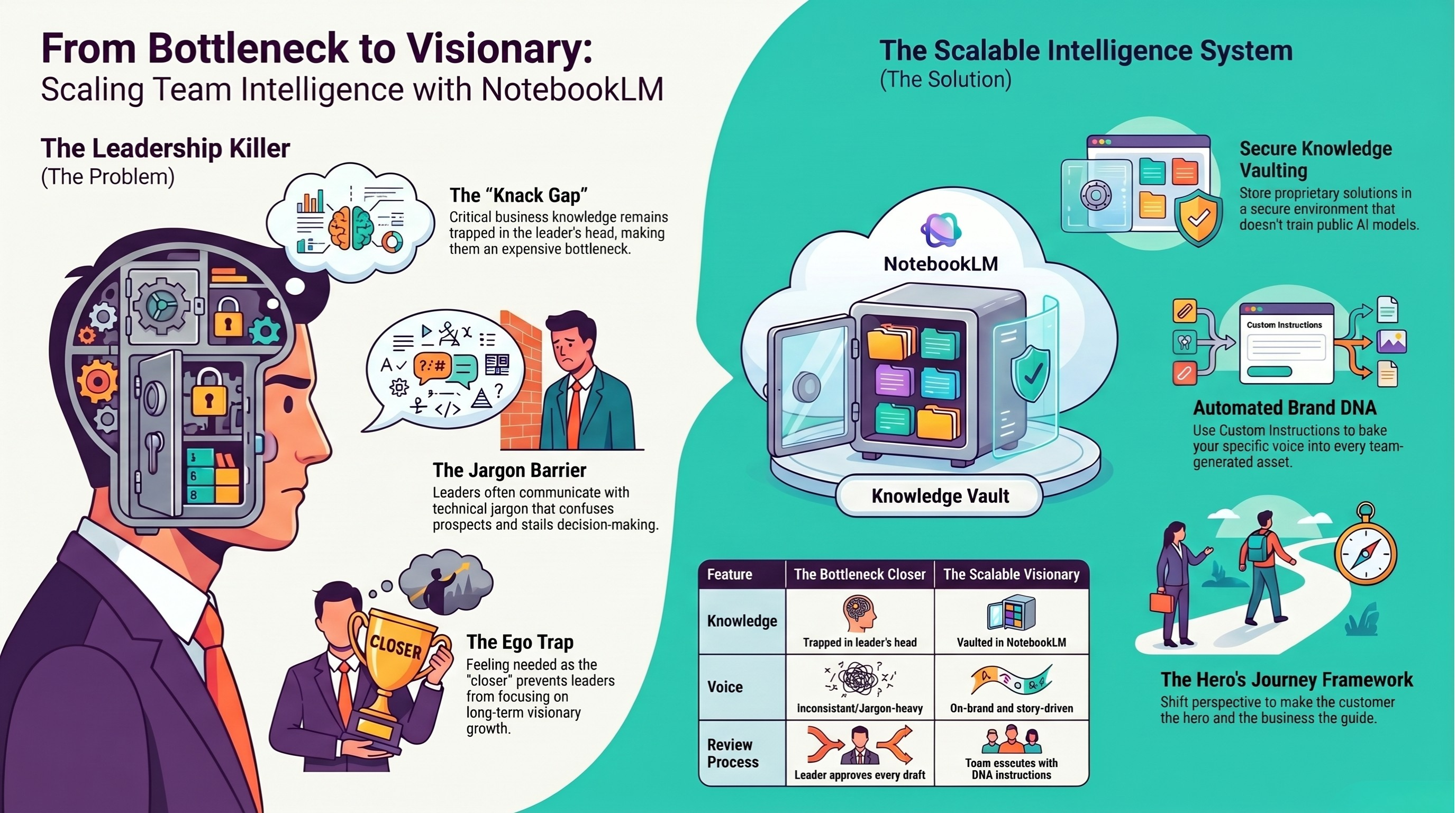
This is often called the “knack gap.” You understand your solution deeply, but your team struggles to communicate it in a way that makes sense to customers.
So what happens?
Your team guesses.
Messaging becomes inconsistent.
Customers get confused.
Deals slow down or fall through.
And when the stakes are high, you step in to save it.
Again and again.
The Hidden Cost of Being the Hero
At first glance, stepping in feels like leadership. But over time, it creates three major problems.
1. Everything Depends on You
Every important decision comes back to you. Your team cannot move forward without approval.
2. Communication Breaks Down
Your team uses jargon or unclear language. Customers do not fully understand the value you offer.
3. You Cannot Scale
If you must be present to close deals or guide messaging, your business cannot grow beyond you.
This is where most leaders get stuck. Not because they lack talent, but because they lack a system.
The Shift: From Gut Feeling to Clear System
The solution is not hiring more people or working longer hours.
The solution is turning what is in your head into something your team can use.
Think of it as building a “battle plan” for your business communication.
A strong system does three things:
Stores your knowledge in one place.
Keeps your messaging consistent.
Helps your team communicate clearly using story.
When these three are in place, everything changes.
Why Story Is the Missing Piece
Here is something simple but powerful.
People do not make decisions based on information alone. They make decisions when they understand a story.
Every customer is already in a story:
They have a problem.
They have tried to fix it.
It has not worked.
Now they are looking for help.
When they meet you, they are not looking for a hero.
They are looking for a guide.
Your job is to show them:
You understand their problem.
You have a clear plan.
You can help them succeed.
When your messaging follows this structure, it becomes easier to understand and easier to trust.
How AI Helps You Build This System
This is where tools like NotebookLM come in. Instead of starting from scratch every time, you build a system once and let your team use it again and again.
Here is a simple way to think about it.
Step 1: Create Your Brand DNA
Your brand already exists. It is in your website, your content, and your past work.
You can gather this and turn it into a clear brand style guide that includes:
Tone of voice.
Key messages.
Visual identity.
Core values.
This becomes the foundation.
Step 2: Build a Secure Knowledge Vault
Instead of letting your ideas stay scattered, you bring everything into one place:
Website content.
Customer reviews.
Case studies.
Internal documents.
This becomes your “vault” of knowledge.
The benefit is simple. Your team now works from the same source of truth.
Step 3: Use Real Customer Language
One of the most powerful but overlooked steps is this.
Use the words your customers already use.
Customer reviews are a goldmine because they show:
How people describe their problems.
What they care about.
What success looks like to them.
When your messaging uses these words, it feels natural and relatable.
Step 4: Turn Everything Into Story
Now you combine your brand, your knowledge, and your customer language into story-driven content.
This can include:
Sales presentations.
Proposals.
Ads.
Social media posts.
Onboarding materials.
The key is consistency.
Instead of each person guessing how to communicate, the system guides them.
What This Looks Like in Practice
Imagine this scenario.
Your team needs to create a sales presentation. Before, they would:
Draft something.
Send it to you.
Wait for feedback.
Revise multiple times.
Now, with a system in place, they:
Pull from the knowledge vault.
Follow the brand style automatically.
Use story-based structure.
Produce something strong on the first try.
You are no longer fixing everything. You are guiding and refining.
That is the difference between being a closer and being a leader.
The Real Win: Freedom and Confidence
When your system works, something powerful happens.
Your team gains confidence. They know how to communicate. They know what to say. They know how to position your solution.
And you gain freedom. You are no longer pulled into every conversation. You can focus on vision, growth, and strategy. Instead of reacting, you are leading.
Final Thoughts
Most businesses do not struggle because they lack value. They struggle because they cannot clearly communicate that value at scale.
When your ideas stay in your head, your growth stays limited.
But when you turn those ideas into a system, everything opens up.
Your team performs better. Your messaging becomes clear. Your business becomes scalable.
Ready to Take the Next Step?
If this feels familiar, you do not have to figure it out alone.
You can set up a strategy or clarity session with Steve and his team. They will help you turn your ideas into a clear system that your team can actually use.
If you want your team to communicate better, close with confidence, and grow with the support of AI, this is the place to start.