
Self-Driving Business: AI & Operations Blueprint
Less routine labor, better critical choices.
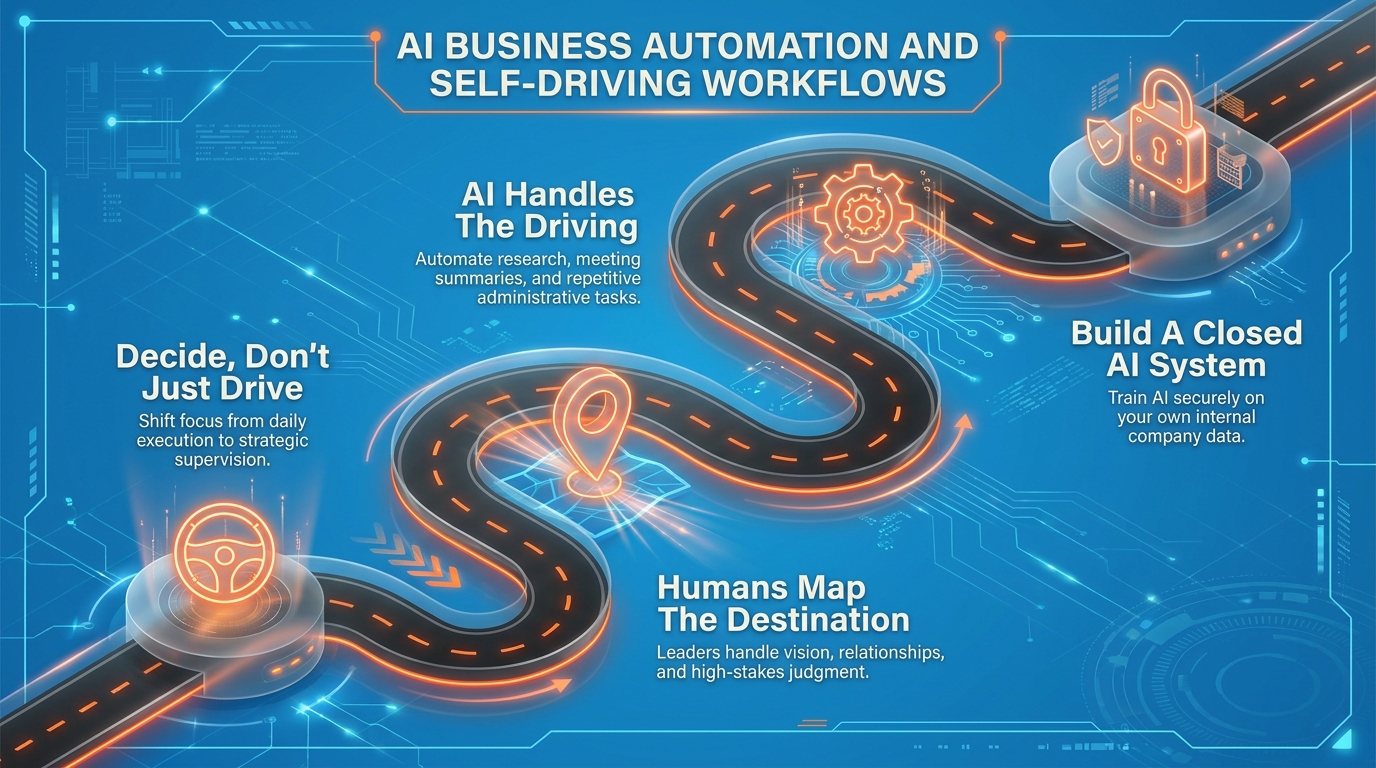
The Cybercab Business Model: Transition your organizational structure from manual "hustle" to a self-driving, AI-supervised engine where top talent dictates the destination rather than steering the vehicle.
The Four Layers of Operations: Stop treating job descriptions as massive blobs of generic tasks. Compartmentalize your business into Destination (Human Experts), Navigation (Human Specialists), Driving (AI Engines), and Pit Crew (AI Automation).
Eradicating Expert-Rate Oil Changes: Prevent your highest-paid closers and executives from hemorrhaging high-leverage energy on low-leverage tasks like drafting emails, hunting for files, or reformatting slide decks.
The Closed-System AI Protocol: Utilize tri-zoned AI platforms (like Gemini Notebook) to build an insulated corporate brain that relies strictly on your proprietary institutional knowledge, effectively leapfrogging the traditional 12-month employee onboarding cycle.
The Strategic Shift: Escaping the Stop-and-Go Trap
If you travel to densely populated global hubs like Manila or El Salvador, you will witness a specific type of daily chaos. Commuters pile into open-air jeepneys—reconfigured World War II relics—or balance precariously on scooters, navigating an intricate, rules-free dance of merging traffic. They endure the heat, the rain, and the wind. They spend an average of four hours a day trapped in stop-and-go gridlock just to get to work and back.
According to Steve ROI Brown, most modern businesses are operating exactly like this Manila traffic jam.
In the "Old Way" of doing business, we romanticize the chaos. We call it "hustle." We applaud executives who are furiously switching between high-stakes judgment calls, drafting emails, hunting for lost PDF files, and reformatting pitch decks. But this is not operational excellence; it is context-switching gridlock. When your most valuable people are bogged down in the administrative minutiae of their day-to-day roles, they are stuck in mental traffic.
Now, contrast that open-air jeepney with a modern Tesla operating on Full Self-Driving, or the newly announced steering-wheel-free Cybercab. The vehicle enters the exact same chaotic environment, yet the passenger sits in an air-conditioned cabin, entirely detached from the physical act of driving. The AI cameras do not blink. They do not get tired. They possess 360-degree visibility, entirely immune to the distractions that plague human drivers. The passenger simply decides the destination, and the machine executes the route.
The strategic shift required for modern enterprise survival is simple: You must remove the steering wheel from your highest-paid talent. You must build a business infrastructure where your human experts are no longer manually steering through administrative chaos, but are instead sitting in the executive suite, deciding the destination while the AI navigates the traffic.
The Core Philosophy: From Driving to Deciding
The prevailing mindset in the corporate world is that adopting AI is simply about doing the same tasks slightly faster. This is a fundamental misunderstanding of the technology's capability.
To achieve massive returns on investment, you must undergo a complete mental shift regarding the division of labor. You have to stop viewing AI as a digital typewriter and start viewing it as an autonomous navigational engine.
"If an AI robot can drive a car through the physical world more successfully, more safer, then an AI virtual robot in your business can do the same thing. And it can be more impactful and get you there safer." — Steve ROI Brown
This is the ultimate "Aha!" moment for business leaders. The physical world is infinitely more unpredictable and dangerous than the digital landscape of your business. If artificial intelligence can process real-time visual data to avoid pedestrians, navigate unmapped construction zones, and safely merge into highway traffic—and do so with a safety record that far exceeds human capabilities—it is more than capable of drafting a meeting summary, formatting a spreadsheet, or querying a CRM.
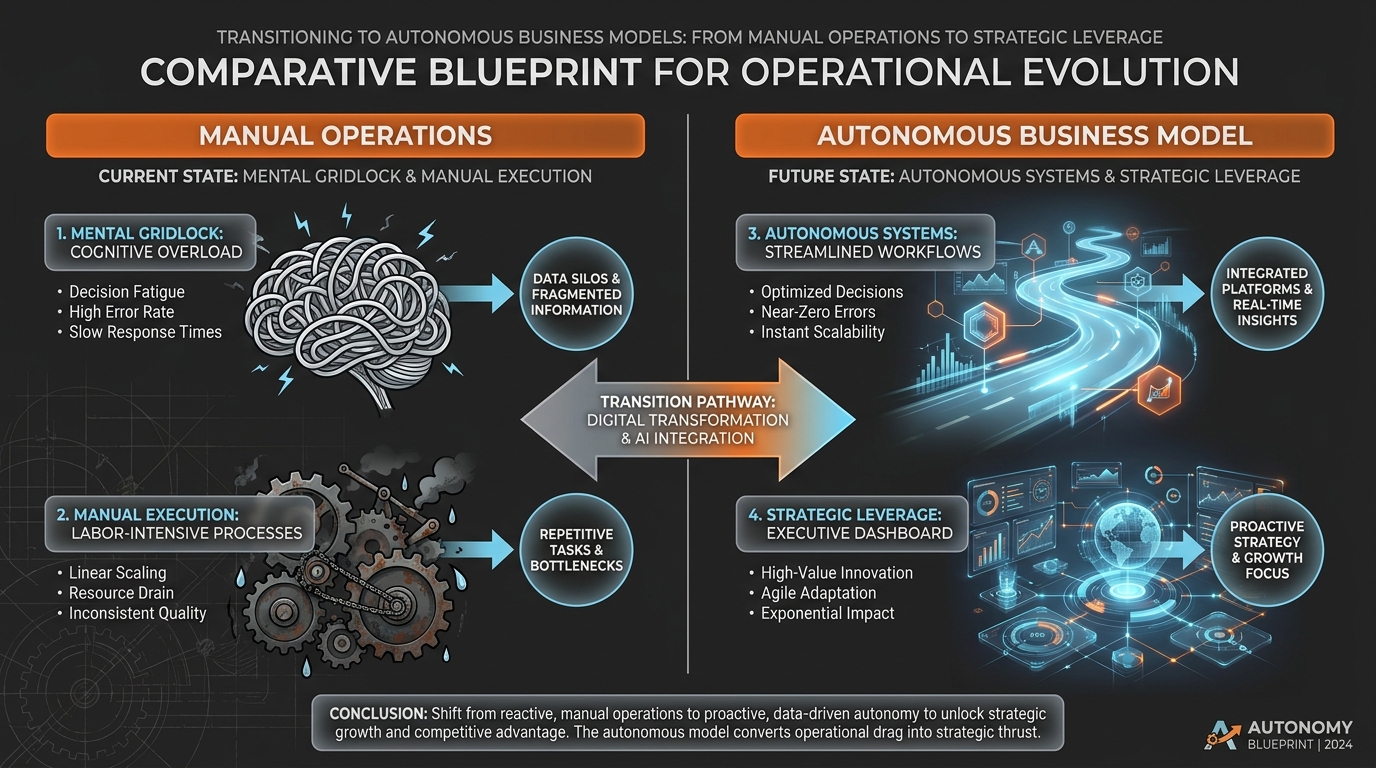
Yet, we continue to force our brightest minds to do the digital equivalent of manually shifting gears in bumper-to-bumper traffic. When an executive attempts to handle high-level strategic relationships while simultaneously rushing through document drafts between meetings, they are not multitasking. They are effectively texting and driving with the company's bottom line. The core philosophy of Steve's proprietary framework is transitioning your workforce from the exhausted state of driving to the leveraged state of deciding.
The Implementation Blueprint: The Four Layers of the Autonomous Enterprise
To transform your organization into a self-driving engine, you must stop treating job roles as massive, indistinguishable blobs of responsibility. You must architect your operations into four distinct layers. This implementation blueprint provides the exact framework to maximize human ROI while delegating the execution to AI.
Step 1: Layer 1 & 2 - Isolating the Human Experts (Destination & Navigation)
The Action: Redefine the roles of your top-tier executives, founders, and key revenue generators. These individuals belong strictly in Layer 1 (Destination) and Layer 2 (Navigation).
In Layer 1, the human expert acts as the visionary. They hold the ultimate accountability for winning. They understand the nuances of your Ideal Customer Profile (ICP), they curate high-level relationships, and they apply refined judgment and taste to the final product. They tell the GPS where the company is going. In Layer 2, your dedicated specialists handle the navigation. They make mid-stream quality calls, coach the underlying work, catch exceptions, and keep the business out of the ditch.
The Business ROI: By isolating your top talent in these two layers, you eradicate the single most expensive leak in your business: misallocated human capital.
"That is a distracted driver with the revenue of your business in the passenger seat," warns Steve ROI Brown, describing the executive who tries to do it all. When your human experts are freed from the mechanical execution of their jobs, their capacity for strategic relationship building and high-stakes problem solving multiplies exponentially. They operate with clarity, unburdened by the friction of scattered files and rushed drafts.
Step 2: Layer 3 & 4 - Delegating the Execution (Driving & Pit Crew)
The Action: Everything that falls beneath high-level judgment must be delegated to your AI infrastructure.
Layer 3 is the "Driving." This is where you deploy AI engines like Gemini Notebook to supervise execution. The AI handles the heavy lifting of deep research, briefing preparations, meeting summaries, initial content drafts, and maintaining the knowledge base. Layer 4 is your "Pit Crew." This utilizes standard automation and specialized AI to handle filing, expense logging, CRM hygiene, document formatting, and routine status updates.
The Business ROI: Cost containment and speed of execution. When a highly compensated sales director spends two hours manually updating a CRM or searching a shared drive for an old case study, the business is actively losing money.
"Oftentimes you're paying your expert rates to change the oil," notes Steve. "If your top closer is spending time doing your layer three and your layer four work, your business is hemorrhaging high leverage energy and money on low leverage tasks." By handing the driving and the pit crew duties to AI, you reduce operational friction to zero, ensuring that expert salaries are paid exclusively for expert output.
Step 3: Architecting the Closed-System Brain (The 3 Zones)
The Action: To make the self-driving business safe and reliable, you cannot rely on the "open web" where AI is prone to hallucinations and generic answers. You must build a closed-system protocol using a platform like Gemini Notebook, divided into three distinct zones.
Zone 1: The Source Area. This is where your business truth lives. You upload strictly approved assets: discovery call transcripts, internal SOPs, product documentation, and client case studies. It operates as an insulated corporate brain.
Zone 2: The Chat Area. This is your internal boardroom. You sit down with the AI and brainstorm, iterate, and strategize based only on the proprietary truth established in Zone 1.
Zone 3: The Studio Area. This is your virtual creative team. Once the strategy is finalized in the Chat Area, the Studio transforms that raw strategic data into perfected, client-ready assets (like slide decks or proposals).
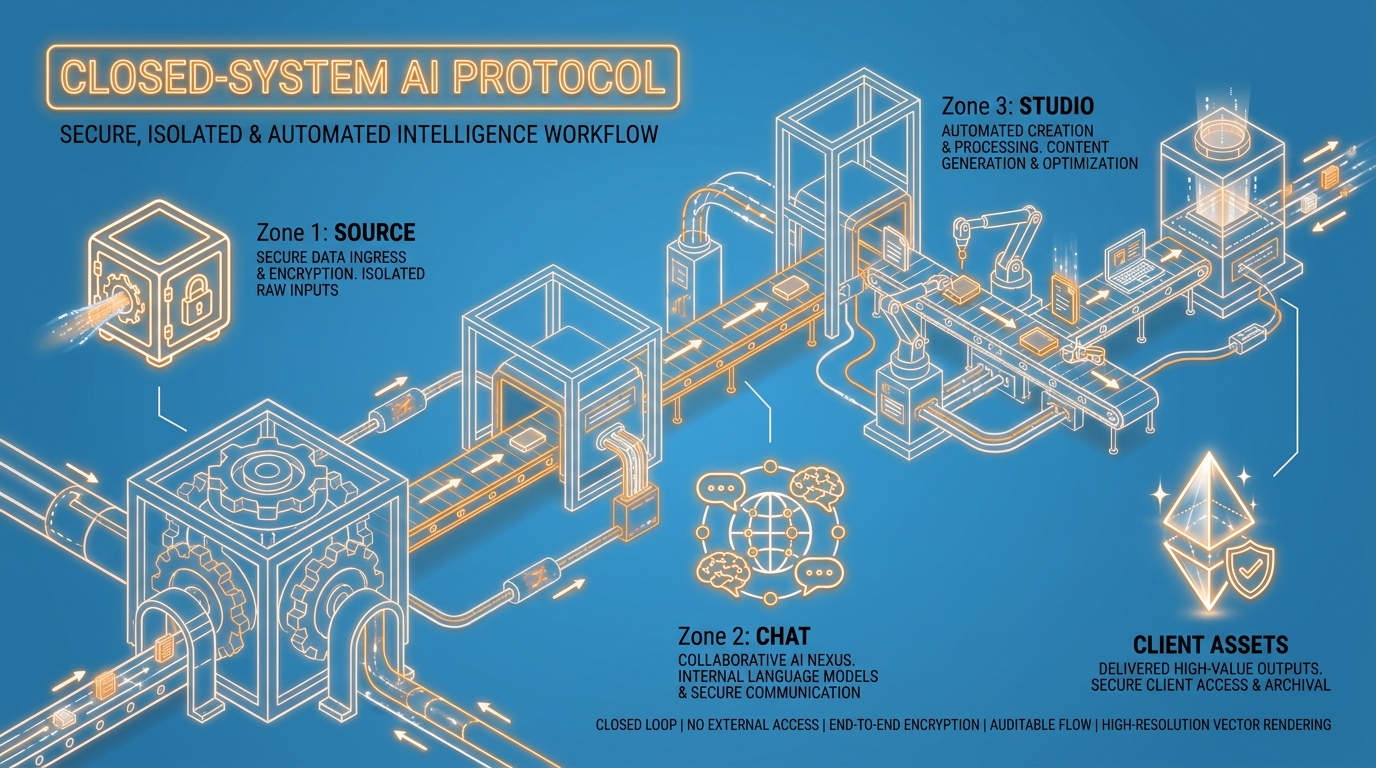
The Business ROI: Instantaneous institutional alignment and drastically reduced onboarding times. Traditionally, when a new employee joins an organization, it takes up to a year for them to fully grasp the nuances of the business, the customer base, and the operational standards. By centralizing your institutional knowledge into a closed AI source area, you leapfrog this entire process. You instantly deploy a digital worker that possesses absolute, perfect recall of your company's entire historical success. From raw data to a perfected asset, your AI engine moves flawlessly without exposing your proprietary data to the public internet.
See the Self-Driving Business in Action
To truly grasp the power of this closed-system protocol, one only needs to look at Steve ROI Brown's own workflow. During the latest episode of AI Made Simple, Steve pulls back the curtain on how the very presentation being delivered was generated.
Rather than spending hours manually formatting slides, hunting for the right images, and agonizing over bullet points, Steve utilized the Zone 3 "Studio" area of his AI notebook. By uploading his raw source documents and having a brief, strategic conversation with the AI in the internal boardroom, the AI natively understood the precise "Golden Thread" of his message. The result? A highly polished, authoritative presentation deck generated from scratch in a matter of minutes. This is what it looks like to dictate the destination and let the AI do the driving. The human expert provided the vision; the digital engine executed the labor.
Business is the most ruthless, competitive environment ever designed by humans. You can no longer afford to wing it. You cannot afford to let your most talented people sit in the stop-and-go traffic of administrative bloat. The technology to build a self-driving, highly leveraged enterprise is available right now.
Stop driving. Start deciding.
To see exactly how Steve puts this approach into practice and how you can begin building a self-driving engine in your own organization, watch the latest AI Made Simple episode on YouTube. Steve breaks down the strategy and implementation in depth so you can see what this looks like beyond the theory.
Turn AI Into a Better Way of Working
Knowing what AI can do is one thing. Knowing where it can make the biggest difference in your business is another.
If you’re ready to move beyond experimenting with AI and start using it to make your team better, set up a strategy and clarity session with Steve ROI Brown. Together, we’ll look at where your team is spending time, where valuable talent is getting pulled into low-value work, and where AI can help your people work smarter, move faster, and focus on what they do best.
The goal isn’t to replace your people. It’s to make them better.
Let’s create a clear path for using AI to build a more capable, focused, and leveraged team.