
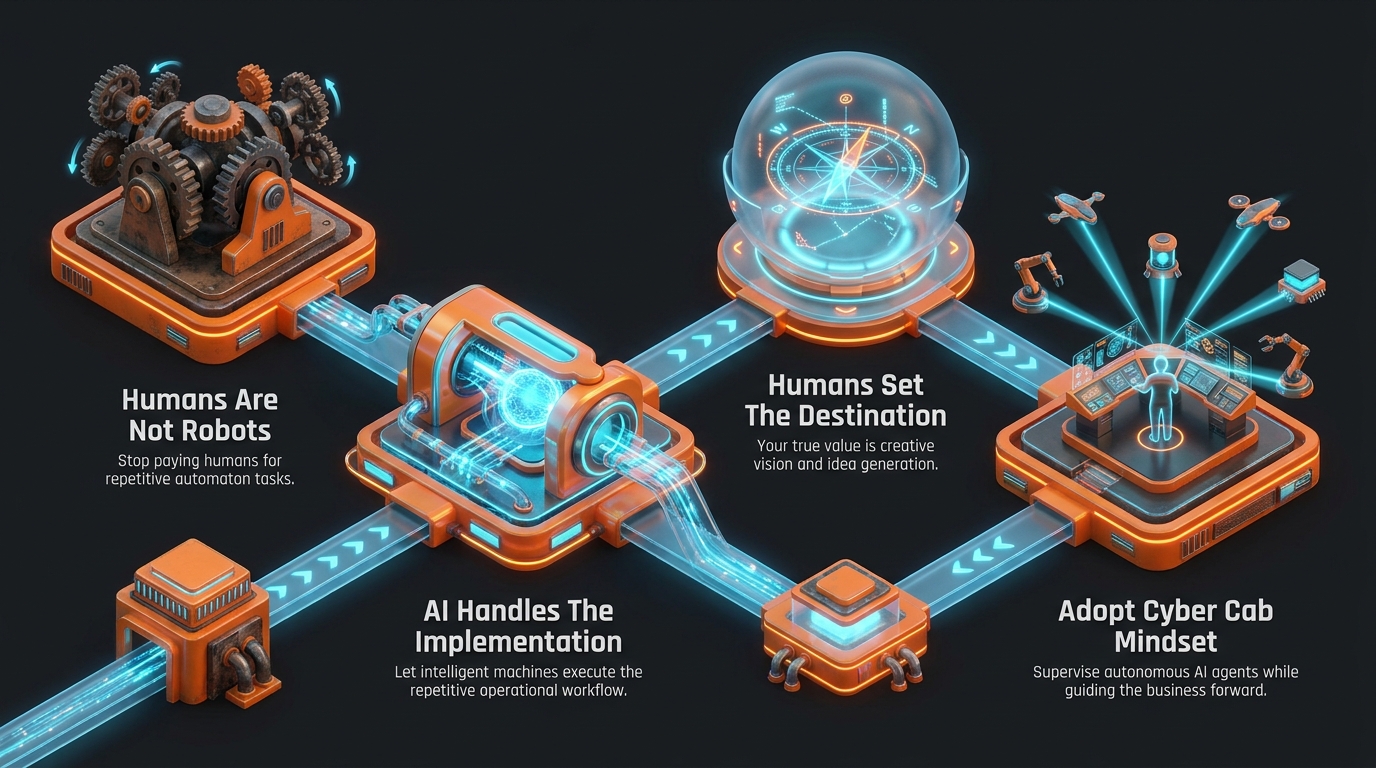
Stop Paying Humans to Be Robots: AI Automation ROI
Calculating the True Cost of Mindless Repeatability
The Brutal Admission of Modern Business: The human element is the most unpredictable, inefficient, and failure-prone component in repetitive business workflows. To scale profitably, businesses must design systems that remove the "steering wheel" entirely.
The Automaton Paradox: We are currently paying premium salaries for humans to act like robots, suffocating their natural creative and visionary capabilities while yielding suboptimal, error-prone results.
Destination-Driven Leadership: The future of organizational ROI relies on treating AI agents like autonomous vehicles. Leaders dictate the destination (the vision) and the intent, while AI algorithms navigate the execution (the "how").
Agent Management over Task Management: The highest-leverage organizations are transitioning their employees from executing manual checklists to supervising fleets of AI agents, drastically multiplying individual output.
The Strategic Shift: Redefining "Labor" in the Age of Autonomy
For over a century, the architectural foundation of business has been built on a single, fundamentally flawed concept: turning humans into predictable machines.
If you analyze the traditional organizational chart, standard operating procedures (SOPs), and multi-tiered approval processes, they all exist for one reason. They are designed to act as guardrails against human unpredictability. In economic terms, we categorize this as "labor." The legacy definition of labor is the act of putting human power into a highly controlled lane to minimize failure, standardize output, and ensure consistency.
According to Steve ROI Brown, this "Old Way" of operating is not only archaic; it is an active drain on your profitability. We have taken the most complex, visionary, and creative asset available to a business—the human mind—and forced it to move digital paper from one inbox to the next.
The modern, high-ROI alternative requires looking outside traditional business frameworks and observing the physical world of autonomous robotics. In epicenters like Austin, Texas, the deployment of fully autonomous "Cybercabs" provides a masterclass in operational efficiency. These vehicles are designed without steering wheels, without brake pedals, and without rearview mirrors.
Why? Because the manufacturers made a brutal, billion-dollar admission: The human is the failure point.
Humans get distracted, they suffer from fatigue, their reaction times vary, and their judgment is inconsistent. When you remove the human from the mechanical act of driving, you reduce weight, cut manufacturing costs, and drastically increase safety—a fact validated by the insurance industry offering massive premium discounts for self-driving supervision. Steve ROI Brown refers to these discounts as the ultimate "receipts"—tangible, financial proof that machines are better at being machines than humans are.
Applying this strategic shift to your business means auditing your org chart and asking a terrifying but necessary question: How much of our payroll is currently dedicated to babysitting the mechanical failures of human inconsistency?
The Core Philosophy: The End of the Automaton Era
To unlock exponential growth, leaders must undergo a radical mental shift. You must stop viewing your employees as implementers of repetitive tasks and start viewing them as visionary directors of AI agents.
This shift mirrors the principles found in Gino Wickman’s Entrepreneurial Operating System (EOS), which cleanly divides organizational roles into "Visionaries" and "Implementers." For decades, businesses had to hire human implementers. Today, AI is the ultimate implementer. The machines are finally ready to do the machine work.
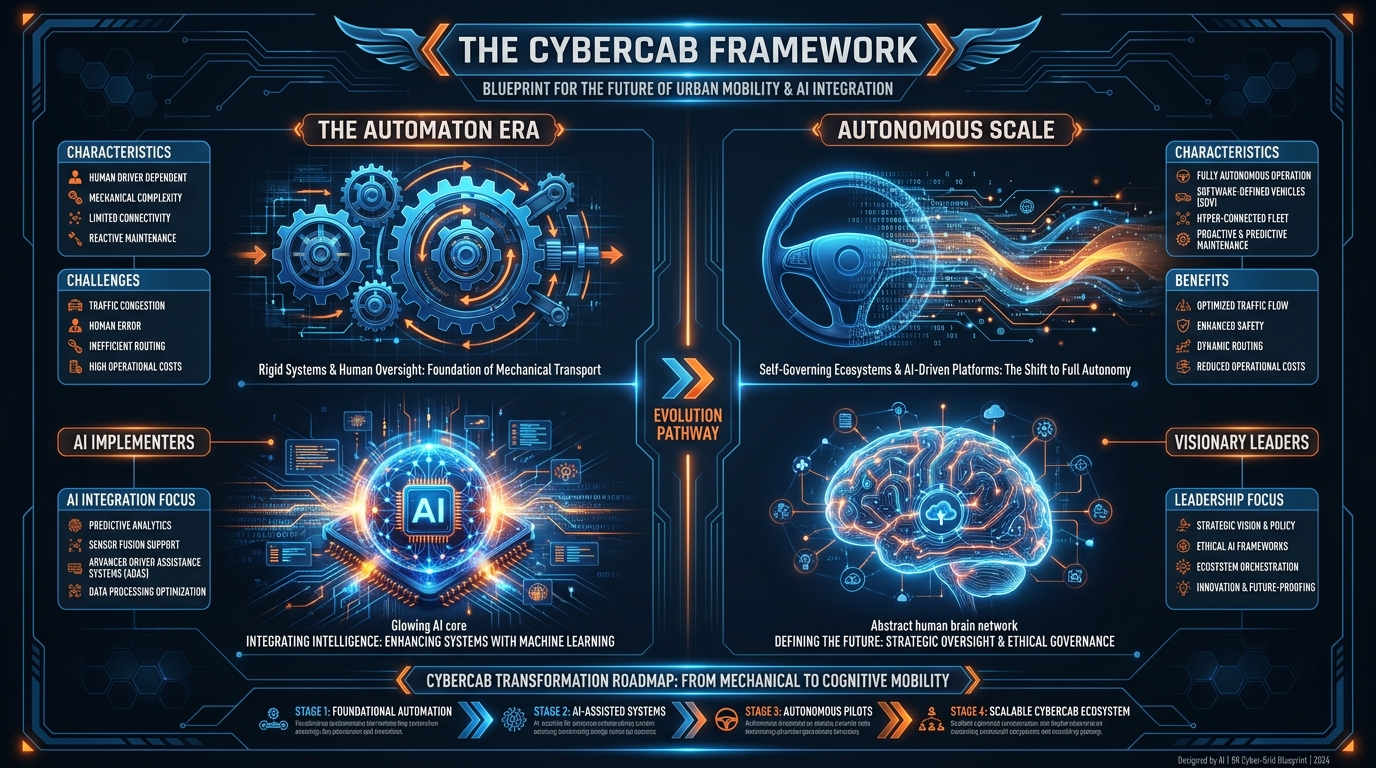
The Cybercab Framework: True organizational scale is achieved only when a business stops paying humans to be robots. By removing the operational "steering wheel" (manual task execution) and handing it to Artificial Intelligence, you liberate your human capital to focus exclusively on high-value, unpredictable, and creative vision-setting—the one thing machines cannot replicate.
The "Aha!" moment for modern executives is realizing why so many employees suffer from burnout and job dissatisfaction. When a human says, "I hate my job," they are rarely complaining about the company's mission. They are complaining about the friction. They hate feeling like an automaton, heavily monitored by SOPs designed to catch their inevitable mistakes.
The fear of AI replacing humans entirely misses the point. The fear isn't about the technology; it’s about acknowledging human limitations in a data-driven world. When you integrate AI to handle the predictable operations, you are not eliminating your workforce—you are rescuing them from the factory floor of modern desk work.
The Implementation Blueprint: Building Your Autonomous Business Engine
Transforming your organization from a legacy labor model into a high-ROI autonomous engine requires deliberate execution. This is not about indiscriminately firing software at your workflows; it is about strategically restructuring how work is assigned, managed, and executed.
Here is Steve ROI Brown’s proprietary blueprint for deploying the Cybercab mindset across your organization.
1. The Automaton Audit (Identifying Operational Drag)
The Action: You must objectively analyze your current workflows to identify where humans are serving as the operational "steering wheel." Look for high-volume, low-creativity tasks: data entry, initial customer service routing, inbox triage, and repetitive report generation. As Steve points out, many businesses are afraid to use AI voice agents for incoming calls, but if you actually listen to recordings of humans answering your business phones, the inconsistency and lack of enthusiasm is often embarrassing.
The Business ROI: By identifying and isolating these tasks, you uncover hidden capital. Every hour an employee spends executing a task an AI could do instantly is an hour of wasted payroll. As Steve notes:
"Stop paying your team to be robots and start implementing a Cybercab mindset. Hand them the one thing the machine can't do and that's to decide where you're going." — Steve ROI Brown
When you eliminate the automaton work, you reclaim wasted payroll and redirect it toward revenue-generating, strategic initiatives.
2. The Destination-First Delegation Model
The Action: In a Cybercab, you do not tell the car when to apply the brakes, how far to turn the steering wheel, or what route to take. You get in, you state your destination, and the vehicle calculates the rest. This is exactly how you must begin interacting with AI inside your business.
Instead of writing exhaustive, step-by-step SOPs on how to do something, leaders must train their teams to communicate the vision, intent, and destination to their AI agents. Software models are updating at a speed humans cannot comprehend. If you try to dictate the "how," you will default to obsolete methods.
The Business ROI: This creates infinite operational agility. When AI handles the mechanics of execution, your business never falls behind the technological curve. The AI always knows the most efficient route.
"If I have an idea and I want to pull off the idea, I go research it, I create it, I brainstorm… and then I come and hand it to my agents and it figures out the how." — Steve ROI Brown
This workflow eliminates the bottleneck of "learning a new software" and allows your team's ingenuity to become a massive competitive advantage.
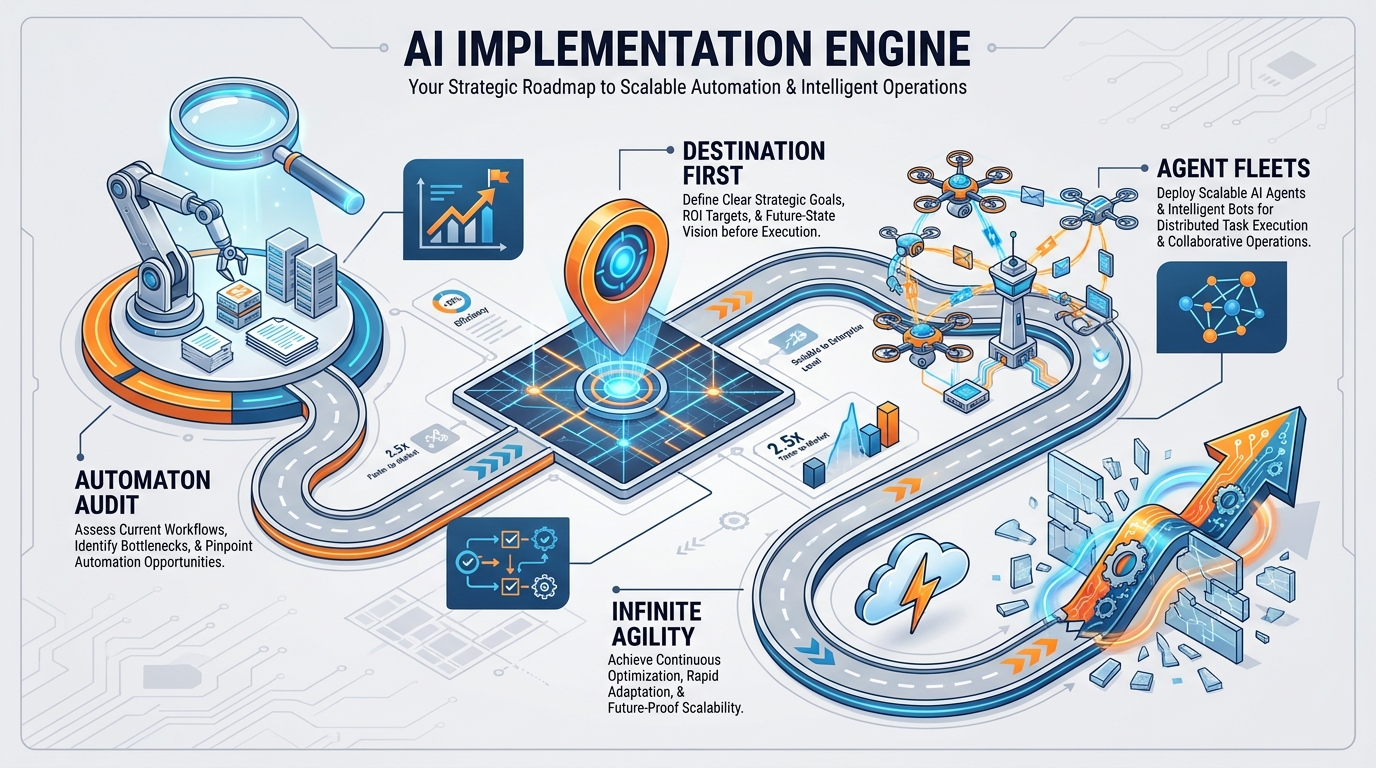
3. Deploying "Supervised Self-Driving" for Teams
The Action: Just as Tesla relies on "Full Self-Driving (Supervised)," your business must adopt a supervised autonomous model. This means giving each of your employees their own suite of AI agents to manage. Instead of managing a personal to-do list, your employees are now managing agent output.
Consider Steve's restaurant management analogy: In the old model, if the dishwasher doesn't show up, the manager steps in to wash dishes. The system degrades because the supervisor is pulled into manual labor. In an AI-leveraged business, if a single node fails, the AI reroutes the workflow, allowing the human supervisor to maintain oversight without sacrificing the entire operation's output.
The Business ROI: This step builds an impenetrable moat of operational resilience. Business owners often complain they cannot take a vacation because their business immediately derails without their hands on the wheel. Supervised self-driving systems ensure that the business stays between the curbs, even when the visionary steps away.
"We're expecting humans to perform as machines, and yet if you let AI take that driver's seat, so to speak, then AI can do the machine part. The machines can be the machines, and you can release your humans to be what they're designed for, creative and visionary." — Steve ROI Brown
See the Cybercab Mindset in Action
The transition from human labor to AI-driven automation is not a distant, futuristic possibility. It is a present-day reality. The businesses that thrive will be the ones that stop paying humans to act like machines and instead empower their teams to become visionary managers of AI fleets.
But understanding the idea is only the beginning. Seeing how it actually works is where the real transformation happens.
In the latest AI Made Simple episode, Steve ROI Brown dives deeper into the Cybercab mindset and shows what it looks like to remove the operational "steering wheel" from your business. He breaks down how to identify repetitive work, give AI the destination instead of micromanaging the route, and free your people to focus on what they are actually designed for: creative and visionary work.
Watch the full episode on YouTube to see Steve unpack the strategy in depth and demonstrate how you can begin building your own autonomous business engine.
The destination is already set. Now it's time to let AI drive.
Don’t Just Automate. Make Your Team Better.
AI works best when you know where you’re going. If you’re not sure which parts of your business should be automated, where your team is getting stuck, or how AI could help your people spend more time on higher-value work, start with clarity.
Set up a strategy and clarity session with Steve to look at your business, identify opportunities for AI, and map out where your people and AI can work better together. The goal isn’t to replace your team. It’s to make your team better. By taking the repetitive work off their plates, you can give your people more room to think, create, solve problems, and lead.