

Make It Make Sense: The Leadership Skill That AI Is Quietly Supercharging
Some people walk into a room and make complicated things feel simple. You know the type. A team is confused. A client is overwhelmed. A project feels messy. Then someone steps in, explains the situation clearly, and suddenly everybody gets it.
That is not just communication. That is leadership.
In today’s world, where people are flooded with information every minute, clarity has become one of the most valuable business skills you can have. The ability to explain a complex idea simply can rally a team, win trust faster, and move projects forward without confusion slowing everything down.
And now, AI tools like NotebookLM are helping leaders do this better than ever before.
Before we go deeper, this topic is also explored in the AI Made Simple podcast, where real examples show how AI can help leaders communicate ideas with more clarity, creativity, and confidence. It is worth watching if you want to see these ideas in action.
Why Complex Ideas Usually Fail
Most bad communication does not come from a lack of intelligence. It comes from starting too deep.
A lot of professionals explain things the way they understand them instead of the way other people need to hear them. That creates a huge gap between expertise and understanding.
Think about how often this happens in business: Someone opens a presentation filled with charts, technical terms, and long explanations. Five minutes later, everyone is quietly lost. Not because the idea is bad. Because the audience never got a simple starting point.
The human brain craves clarity. It wants patterns, visuals, and stories that make information easier to process. That is why people remember movies better than meetings and stories better than spreadsheets.
The leaders who understand this have a massive advantage.
Stop Throwing People Into the Deep End
Imagine teaching someone to swim by tossing them into the ocean. That sounds ridiculous, but it is exactly how many people explain complicated topics. They overload people immediately. The better approach is to guide them slowly into understanding. One step at a time.
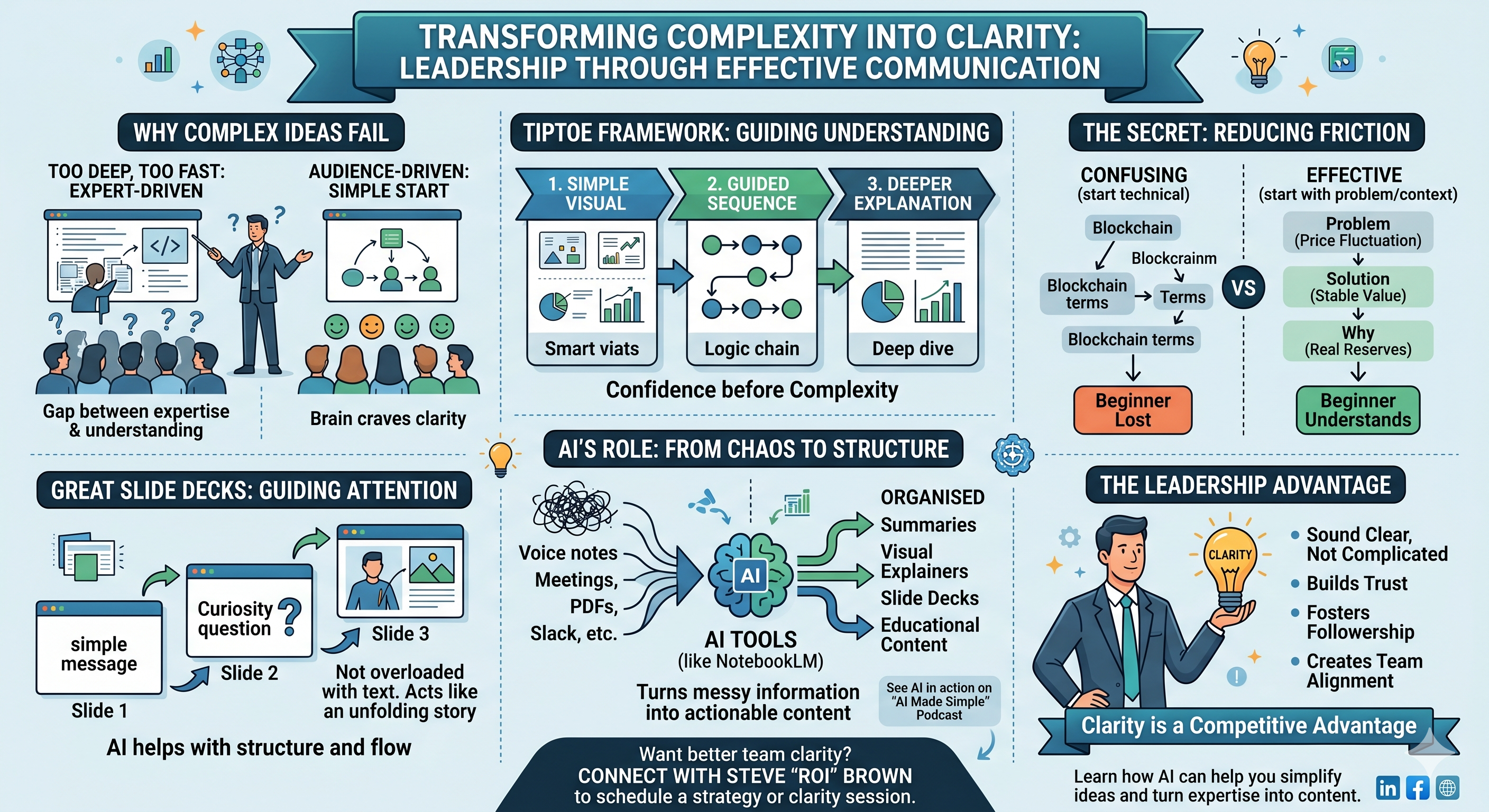
That is the idea behind what can be called the “Tiptoe Framework.” Instead of overwhelming people with technical details right away, you gradually help them build understanding through three layers:
A simple visual.
A guided sequence of ideas.
A deeper explanation for those who want more.
It works because people need confidence before they need complexity.
Why Visuals Work So Well
Long before presentations existed, humans communicated through pictures and symbols. There is a reason for that. Visual storytelling works faster than raw information. A single image can explain emotion, tension, relationships, and outcomes almost instantly. Meanwhile, paragraphs of text require effort, focus, and patience.
This is where AI becomes surprisingly powerful. Tools like NotebookLM can take scattered notes, documents, interviews, and research and help turn them into visual explanations that are easier to follow. Instead of handing someone a ten-page explanation, you start with one clear image that tells the story.
That changes everything.
The Secret Behind Great Explanations
Great communicators do not just share information. They reduce friction. They remove the mental effort people normally experience when trying to understand something new.
One of the best ways to do this is through storytelling structure. For example, think about how you would explain stablecoins to someone unfamiliar with cryptocurrency. Most people would start with technical language about blockchain systems, decentralized finance, or digital assets. That immediately loses beginners.
A stronger explanation starts with a problem people already understand: Regular cryptocurrency prices move up and down too fast to work well for everyday purchases. Now the audience has context.
Then you introduce the solution: Stablecoins are digital currency designed to maintain a steady value.
Then you explain why they stay stable: They are backed by real-world reserves like cash.
Now the listener feels smart instead of confused. That shift matters more than most people realize.
AI Turns Information Into Something People Can Actually Use
One of the biggest hidden problems inside companies today is information overload.
Ideas are everywhere:
Voice Notes
Meetings
PDFs
Slack Messages
Brainstorming Sessions
Training Calls
Random Documents
The problem is not a lack of information. The problem is that nobody has time to organize it all clearly.
That is where AI tools become incredibly useful. Instead of spending hours trying to structure messy information manually, leaders can upload conversations, notes, and research into NotebookLM and start shaping those ideas into summaries, visual explainers, slide decks, and educational content.
What once felt chaotic suddenly starts making sense. And when ideas make sense, teams move faster.
The Real Power of Slide Decks
Most slide decks are overloaded with text because people treat them like documents. But strong presentations are not supposed to contain every detail. They are supposed to guide attention.
A great slide deck feels more like a story unfolding than a report being read aloud. Each slide should answer one question while creating curiosity about the next one.
This is another area where AI can help leaders dramatically improve communication. Instead of struggling to structure a presentation from scratch, AI can help organize information into a sequence that flows naturally and keeps people engaged. That matters because attention is one of the hardest things to earn today. If people are confused, distracted, or overwhelmed, they stop listening.
The Best Leaders Sound Clear, Not Complicated
There is a common myth in business that sounding more complex makes people sound smarter. Usually, the opposite is true. The most respected leaders are often the ones who can explain difficult ideas in plain language. They know how to remove unnecessary complexity without removing meaning. That skill creates trust. People naturally follow leaders who make them feel informed instead of intimidated.
And this applies far beyond leadership meetings. It matters in:
Sales Conversations
Marketing
Training
Customer Communication
Team Alignment
Strategy Sessions
Clarity is not a “soft skill” anymore. It is a competitive advantage.
From Information Overload to Clear Thinking
Most teams today are not struggling because they lack ideas. They are struggling because they are buried under too many disconnected thoughts, documents, and conversations.
AI can help bridge that gap. Not by replacing human expertise, but by helping humans organize and communicate that expertise more effectively.
That is the real opportunity.
The future does not belong to the people with the most information. It belongs to the people who can make information understandable. And in a world filled with noise, the ability to “make it make sense” may become one of the most valuable leadership skills of all.
If you want your team to communicate with more clarity, confidence, and creativity, connect with Steve ROI Brown to schedule a strategy or clarity session. Learn how AI can help your leaders simplify complex ideas, create stronger communication systems, and turn everyday expertise into content and conversations people actually remember.