

Turn Confusion Into Clarity With AI and NotebookLM
Most leaders carry a clear vision in their heads, but getting that vision into someone else’s head is hard. You might know your product, strategy, or plan inside out. Yet when you try to explain it to your team, a prospect, or a partner, the message can land as confusing, technical, or “too much right now.”
That gap is costly. When people do not understand, they hesitate. They tune out. They fall back on assumptions and distractions. Your ideas do not move forward, not because they are wrong, but because they are not clear.
The good news is that clarity is not a personality trait. It is a skill. And with the right AI workflow, you can get dramatically better at it faster than you might think.
Before we get into the details, this same theme is also covered in the AI Made Simple podcast. You can watch it on YouTube if you want extra examples of how AI supports clear and creative leadership.
Why Clarity is the Real Leadership Advantage
People follow leaders who make complicated things feel understandable. Think of any communicator you admire, whether in business, writing, or product innovation. They do something special:
They reduce confusion without oversimplifying.
They connect details to meaning.
They help you see where something fits into your life or work.
When you do that for your team or your market, trust increases. Speed increases. Buy-in increases.
But there is a catch. You have very little time to earn attention. People are dealing with constant interruptions: notifications, meetings, family, emails, and a million small decisions. On top of that, they already have pre-built opinions.
For example, say you mention “crypto.” Many people immediately think “risky” or “volatile.” That reaction might have nothing to do with what you mean, but it still shapes how they hear you. So your job is not only to explain your point. Your job is to guide their mind past the mental noise and into understanding.
Story is not hype. It is compression.
A lot of people confuse storytelling with marketing. They think storytelling means catchy slogans, dramatic launch videos, or content designed to trigger quick reactions.
Real storytelling is different. It is about compression.
Compression means taking something complex and expressing the most important truth in a way that people can grasp quickly. It is not about dumbing it down. It is about making it usable.
In a business setting, great storytelling does three things:
It turns complicated systems into simple meaning. People do not need all the details first. They need the point first.
It connects features to human impact. A feature matters when someone understands what changes because it exists.
It earns time. Once someone “gets it,” they will slow down and ask better questions. You have their attention.
This is why great product communicators stand out. They can explain a technical decision and make you feel the value right away.
Why Visuals Matter More Than Ever
Words are powerful, but visuals are fast.
Your brain can understand an image almost instantly. That is why billboards work. That is why diagrams can teach in seconds what paragraphs struggle to explain.
Visuals reduce cognitive load. They help your audience form a mental model quickly. Once that model exists, your words have a place to land.
This is a big shift in how leaders communicate today. The leap is not just better text. It is visual support that makes the message “click.”
Here is the practical pattern:
Start with a clear visual that signals the idea.
Guide the audience through a simple path or structure.
Then bring in more detail after trust is earned.
AI now makes this process accessible even if you are not a designer or a professional presenter.
NotebookLM as a “Clarity Engine” for Leaders
NotebookLM is a tool that helps you take messy information and turn it into usable clarity. The key idea is simple: you feed it your source materials, and it helps you transform them into explanations and assets you can actually use.
Instead of staring at a pile of documents and trying to piece everything together, you create a focused workspace where the AI can help you think, organize, and communicate.
What you can feed into it.
You can bring in many types of sources, such as:
Documents and Notes
PDFs
Website Content
Copied Text
YouTube Transcripts
Internal Materials like Training Docs or Sales Messaging
The goal is to collect the “truth” you want to communicate and put it in one place.
What Makes It Different
NotebookLM works best when you treat it like a thinking partner, not a magic wand. It shines when you do two things:
Concentrate the right sources. You are building a mini-library around one idea.
Ask strong questions. The quality of your output depends on the quality of your prompts.
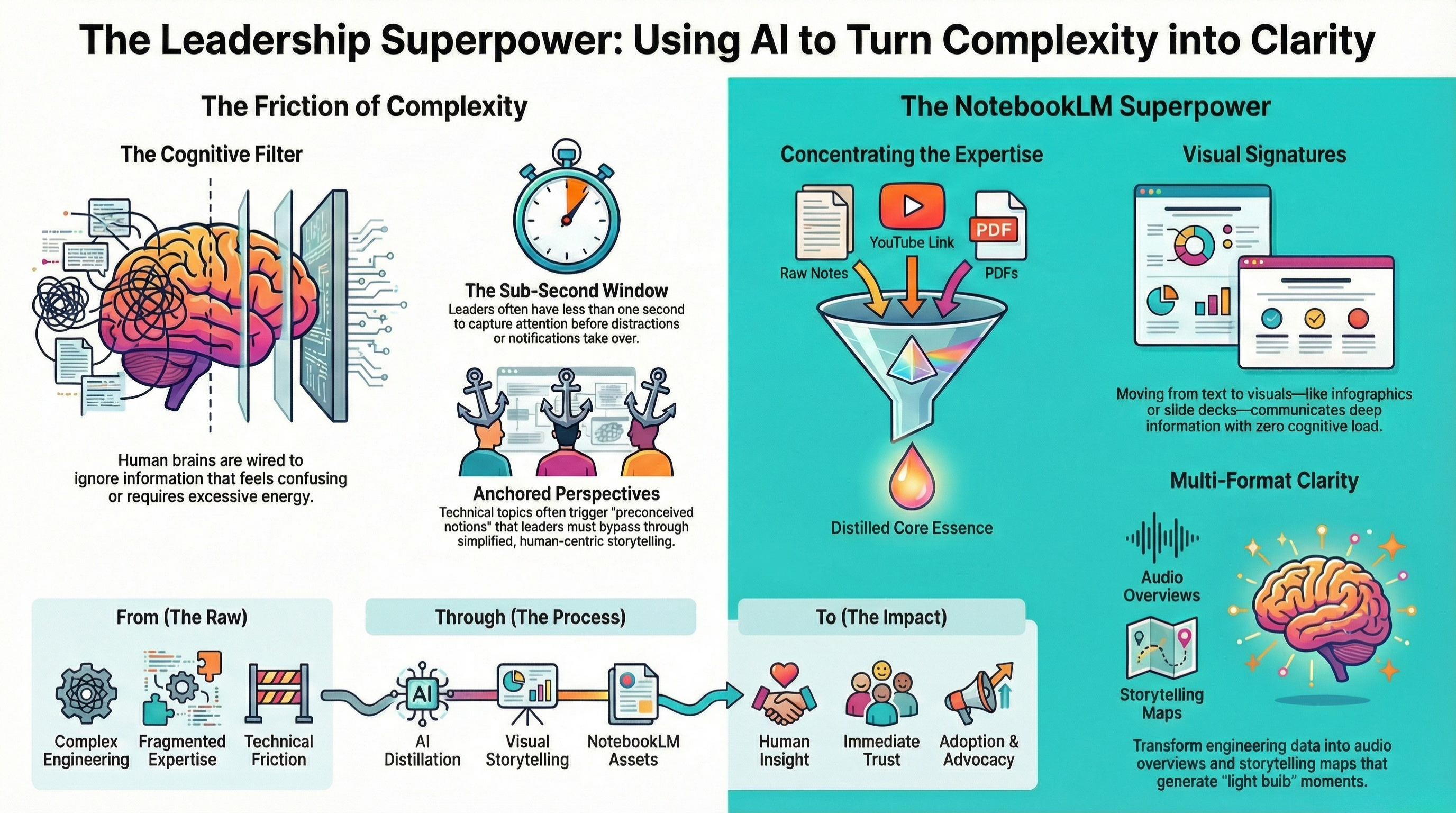
The Questions Leaders Should Ask to Create Clarity
If you ask shallow questions, you will get shallow results. Leaders get the most value by asking the kinds of questions they already know how to ask in real life.
Here are examples that consistently produce better clarity:
“What’s at stake if someone doesn’t understand this?” This reveals urgency and consequences.
“What are the common misconceptions people bring to this topic?” This helps you address the mental barriers upfront.
“Explain this in plain language for a smart person who is new to it.” This helps you avoid jargon without losing substance.
“Give me a simple story that shows the before and after.” This creates movement and meaning.
“What’s the shortest explanation that still feels true?” This is where real compression happens.
When you consistently ask questions like these, your message becomes clearer, sharper, and easier to repeat across your team.
Turning One Idea Into Multiple Assets
Once your sources and insights are in place, you can use NotebookLM to create different formats that support different learning styles.
This matters because your audience is not one brain. Some people need a quick summary. Some need a visual map. Some need repetition.
Useful outputs include:
A short, clear overview you can say out loud.
A structured outline for a talk or meeting.
A mind map to show relationships between ideas.
A set of FAQs to handle objections.
A slide outline that follows a logical path.
A training-style quiz or flashcards to lock in understanding.
This is how you stop relying on one explanation. You build a small set of “clarity tools” that make your message consistent.
And consistency is what builds trust across sales, marketing, leadership, and delivery teams.
A Simple Workflow You Can Copy Today
If you want to use AI to communicate more clearly, here is a straightforward process:
Pick one complex topic you need to explain. This could be a product feature, a strategy shift, or a new offer.
Collect 3 to 7 solid sources. Add your notes, customer questions, docs, and any helpful external references.
Ask for the essence first. Get a simple summary, key points, and what matters most.
Ask what people misunderstand. Clarify the assumptions and objections you are up against.
Generate assets for communication. Create a slide outline, an infographic concept, a mind map, and a short narrative.
Use visuals early, details later. Lead with what the brain can grasp quickly, then go deeper once attention is earned.
Get your team clear with the right AI strategy.
If your product or service is hard to explain, you do not have a “marketing problem.” You have a clarity problem. And clarity is solvable.
If you want help building a repeatable way to communicate your value, align your team, and create visuals and messaging that actually land, book a strategy or clarity session with Steve.
We will help you turn what’s in your head into a clear story, a visual explanation, and a system your team can use every day. With AI in the workflow, you can move faster, sound sharper, and lead with more confidence.