
Turn Your Ideas Into Stories People Actually Understand with AI
You have probably felt this before. You have a great idea in your head. You know your product works. You know your message matters. But when it is time to explain it, something feels off. The words do not land. The visuals feel flat. The message misses.
That gap is not because your idea is weak. It is usually because the story is unclear.
Before we go deeper, this topic is also explored in the AI Made Simple podcast. You can watch it on YouTube if you want to see how AI can help you communicate with more clarity and creativity in real situations.
Every Message Is a Story
Think about your day. Even the simplest task follows a pattern.
You start in a normal state. Then something changes. A challenge appears. You feel unsure. You push through. You solve it. Then you return, but better than before.
That pattern is called the hero’s journey. It shows up everywhere:
A sales call.
A website page.
A presentation.
Even a simple email.
If your message does not follow this flow, people struggle to connect with it.
Now imagine this. Your customer is already in the middle of their own story. They are not starting from zero. They are dealing with confusion, pressure, and risk. When they see your message, they are asking one thing:
“Does this help me move forward?”
If your content does not clearly answer that, they move on.
Why Most Communication Falls Short
Here is the hard truth. Most people are not trained storytellers.
So what happens?
They overload slides with information.
They explain features instead of outcomes.
They forget the emotional journey of the audience.
The result feels like noise. Not because the content is bad, but because it is not structured in a way the brain understands.
People do not remember data. They remember stories.
And this is where AI becomes powerful.
AI Understands Story Better Than You Think
Tools like NotebookLM are not just for research. They are powerful communication tools.
What makes them special is this: they naturally organize information into a story structure.
You do not even have to explain the hero’s journey. The tool already leans toward it.
When you give it content, it starts to:
Identify the starting point.
Highlight the tension or problem.
Build a path forward.
Show a resolution.
This means you are no longer starting from a blank page. You are starting with a structure that works.
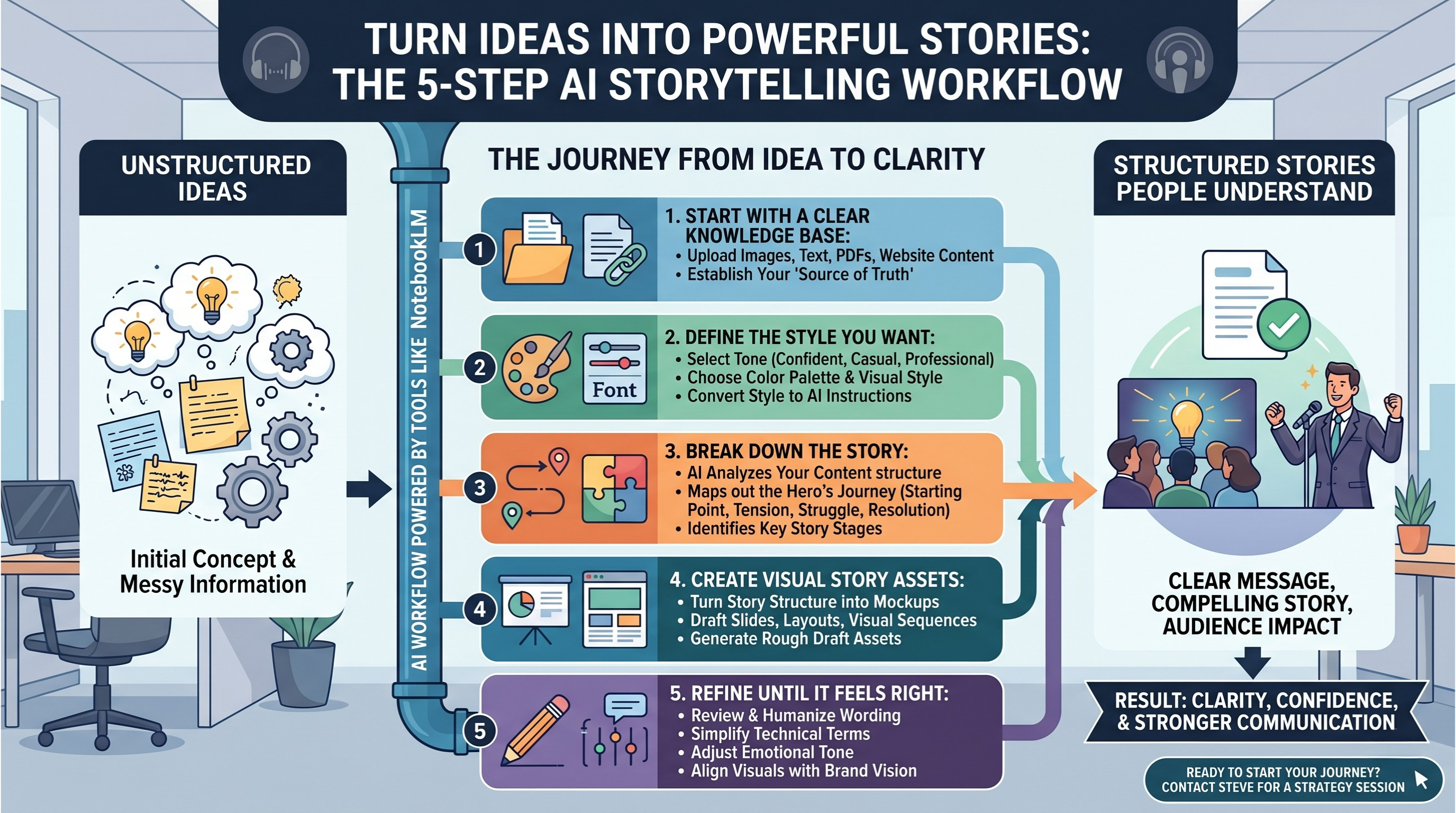
#1: Start With a Clear Knowledge Base
Before asking AI to create anything, you need to give it the right inputs.
Think of this as your foundation.
Inside NotebookLM, you can upload:
Images
Text
Documents
Website Content
This becomes your “source of truth.”
The key idea is simple. If you put strong, clear content in, you get strong, clear results out.
If you rush this step, the output will feel generic.
But if you take time to curate your inputs, the AI becomes much more precise.
#2: Define the Style You Want
Let’s say you see a design you love. Maybe it has clean lines, bold colors, and a confident tone.
You may not know what that style is called. That is okay.
You can ask AI to describe it.
Then you take that description and turn it into instructions. This includes:
Color Palette
Tone of Voice
Visual Style
Level of Detail
Now the AI is not guessing anymore. It is following your direction.
This step alone can change everything. Instead of random outputs, you start getting results that feel aligned with your brand.
#3: Break Down the Story
Once your source and style are set, you can ask AI to analyze your content.
For example, you can say:
“Explain this image using the hero’s journey.”
The result will often break your content into stages like:
The starting point.
The moment of decision.
The struggle.
The turning point.
The resolution.
Now you are no longer guessing how to present your idea. You can see the structure clearly.
This is where clarity starts to build.
# 4: Create Visual Story Assets
Here is where things get exciting.
You can ask AI to turn your story into:
Slide Decks
Infographics
Visual Sequences
Web Page Layouts
At first, it may not be perfect. That is normal.
You might feel like the output is close, but not quite there.
That is actually part of the process.
#5: Refine Until It Feels Right
This is where most of the real work happens.
You review the output and adjust:
Change the wording to feel more human.
Simplify technical phrases.
Adjust emotional tone.
Align visuals with your vision.
Each revision gets you closer. You move from “I have an idea” to “I can clearly show and explain this.” And that shift is powerful.
Why This Matters for Your Business
When your communication improves, everything changes.
Your team becomes clearer. Your presentations become stronger. Your customers understand faster.
More importantly, your audience feels guided.
Instead of confusion, they experience:
Clarity
Confidence
Direction
And that is what builds trust.
Remember, your customer is already in their own journey. They are facing risk and uncertainty. When you show them a clear path forward, you become the guide they need.
The Real Win: Confidence in High-Stakes Moments
Think about your next important conversation.
A sales pitch. A strategy meeting. A proposal.
Now imagine walking in with:
Clear Visuals
A Strong Story
A Simple Message That Connects
You are not guessing anymore. You are leading. That is the real value of using AI this way. It is not just about saving time. It is about showing up prepared and confident when it matters most.
Your Next Step
If you feel like your message is not landing the way it should, you are not alone. Most teams struggle with this.
The good news is you do not have to figure it out on your own. If you want help turning your ideas into clear, powerful stories that actually connect, consider setting up a strategy or clarity session with Steve. You will walk away with:
A clearer message.
A stronger story structure.
Practical ways to use AI in your workflow.
And most importantly, you will be better equipped to lead your team and communicate your value with confidence.
Sometimes the difference between being understood and being ignored is just clarity. Let’s build that clarity together.