
Walled-Garden AI Hiring: Stop Vending Machine Recruiting
The Walled-Garden AI Framework for Custom Talent Acquisition
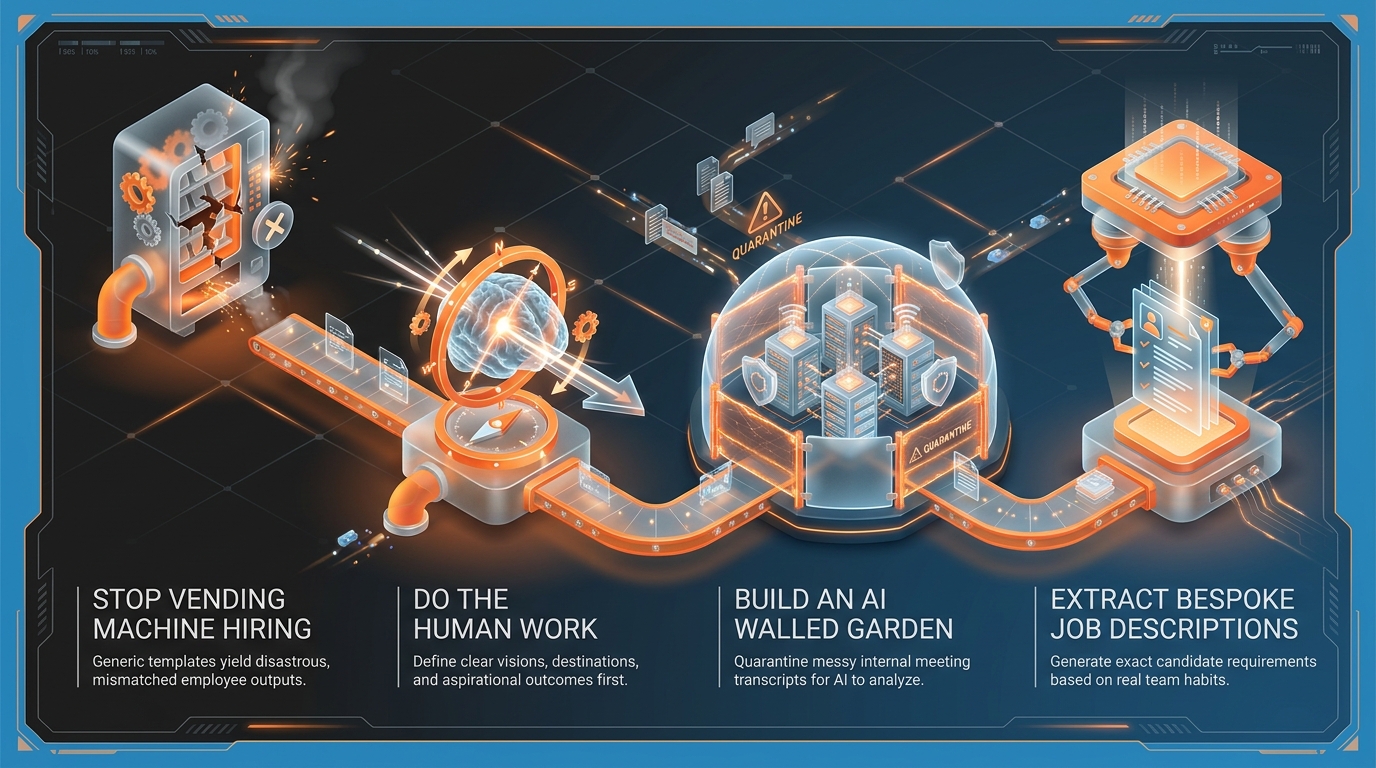
The "Vending Machine" Trap: Relying on generic job templates forces leaders to select the "least worst" option from a pool of misaligned candidates, virtually guaranteeing expensive 90-day turnover.
The Walled-Garden AI Strategy: By quarantining proprietary company data (e.g., raw project meeting transcripts) inside an AI notebook environment, businesses can engineer bespoke roles based on their exact operational reality.
Zero-Hallucination Output: Utilizing tools like Gemini Notebook or NotebookLM allows leaders to eliminate internet "slop" and force the AI to draft requirements based strictly on how the internal team actually works.
Relieving Executive Cognitive Load: Transitioning the heavy lifting of job design, expectation mapping, and targeted interview question generation to an AI "thinking partner" frees up vital leadership bandwidth.
The Strategic Shift: Abandoning the Status Quo
The High Cost of the "Least Worst" Option
Picture yourself walking through an airport terminal after a long, exhausting day. You are starving. You approach a vending machine, peer through the glass, and what do you see? A highly limited selection of artificial, chemical-laden, sugar-filled snacks. None of it is what you actually want or need. But because you are hungry and constrained by the machine's inventory, you put your money in and select the "least worst" option.
According to Steve ROI Brown, this exact scenario mirrors how 90% of organizations handle their talent acquisition. When a gap opens up in a company, panic sets in. The immediate executive reflex is to find a generic job description template for a "receptionist" or "project manager," tweak a few bullet points, push it live on a job board, and hope for the best.
This is the old way of hiring. It is entirely reactive, heavily reliant on gut feeling, and incredibly dangerous. When you rely on generic inputs, you are artificially limiting your choices to a predetermined pool of candidates who look good against a generic template, but who possess zero alignment with your company's actual, messy reality.
Moving from Transactional to Architectural
The status quo treats hiring as a simple transaction. A seat is empty; a warm body must fill it. But operating your business this way is like having a fully capable autonomous vehicle at your disposal, yet insisting on white-knuckling the steering wheel through rush-hour traffic.
Steve's modern, high-ROI alternative flips this paradigm. Instead of asking, "What template do we need?" high-performing leaders must ask, "How can we use our existing internal data to engineer the exact candidate our business actually needs?"
By leveraging artificial intelligence not as a simple text generator, but as a strategic thinking partner, organizations can move away from the vending machine model. The goal is to analyze the unique data footprint of your organization to create a bespoke position. This custom-tailored approach dramatically increases your success rate, ensures proper expectation setting, and protects your bottom line from the catastrophic costs of a bad hire.
The Core Philosophy: The Mental Shift to Bespoke Hiring
The defining mental shift required to modernize your hiring process is recognizing that the best job descriptions are not written—they are extracted.
Most leaders simply do not have the bandwidth, the cognitive energy, or the temperament to sit down and meticulously analyze the granular details required to map out a truly successful role. Because of this lack of time, we default to shortcuts. We assume we know what the business needs, but our gut feelings are often disconnected from the daily operational friction our teams experience.
"Most business owners treat hiring like a transaction. You drop a blank template into the machine and expect a perfect employee to pop out. But that transactional inputs guarantees disastrous outputs." — Steve ROI Brown
To break this cycle, you must stop relying on external templates and start relying on internal truth. The truth of your business is hidden in your daily operations—your meetings, your project check-ins, the balls that get dropped, and the rabbit trails your team goes down.
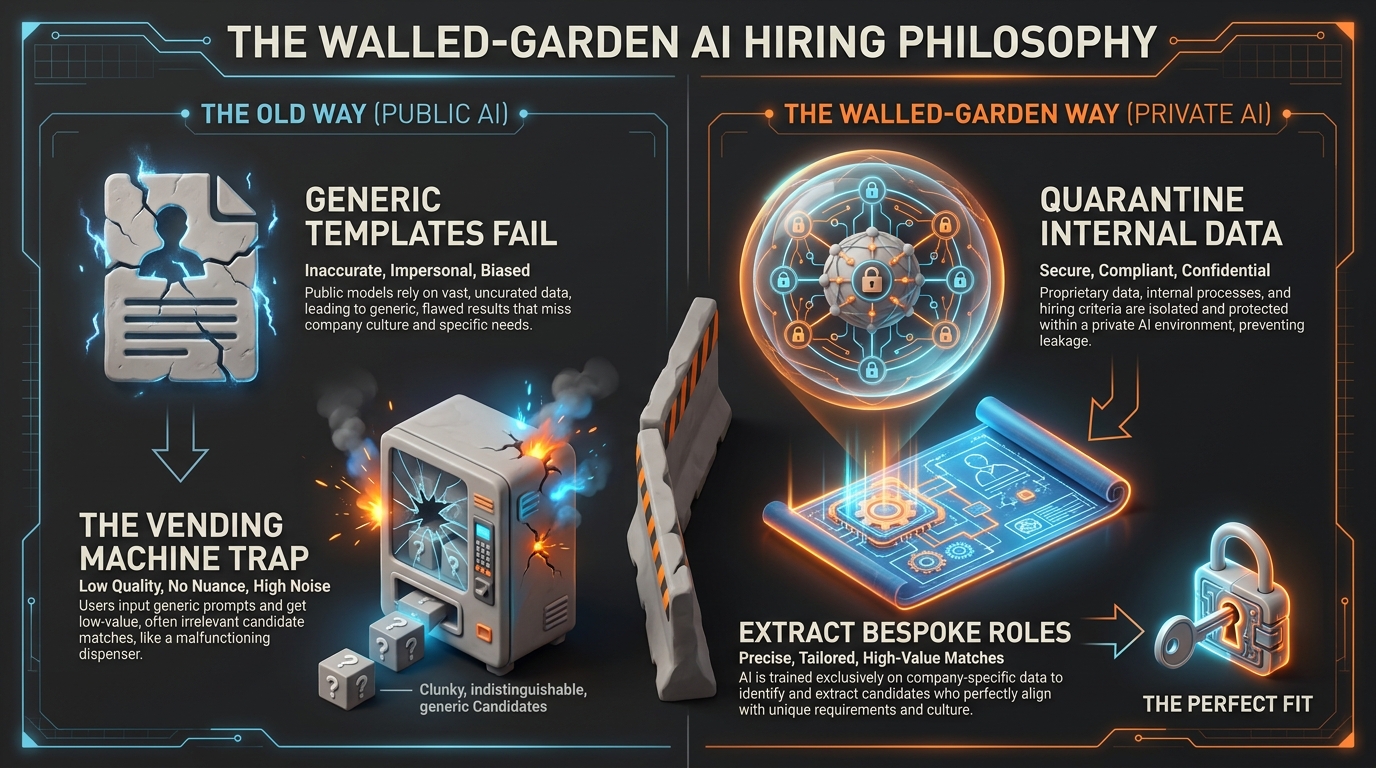
The proprietary framework introduced by Steve ROI Brown relies on the concept of "Quarantine." When you are sick, you quarantine yourself to prevent the spread of a virus. When you are using AI to build a crucial business asset like a job description, you must quarantine your AI. You cannot let it search the open internet, because the open internet is filled with generic, unrelated "sickness" and "slop."
You must lock the AI inside a Walled Garden containing only your actual company data. When you force an LLM (Large Language Model) to look exclusively at your operational reality, the resulting "Aha!" moment is profound: The AI will identify the exact gaps in your team's workflow and write a job description designed specifically to solve your unique problems, not industry-average problems.
The Implementation Blueprint
To execute this strategy and achieve maximum ROI, you must follow a deliberate, multi-step architecture. This methodology removes the guesswork from hiring and replaces it with data-driven clarity.
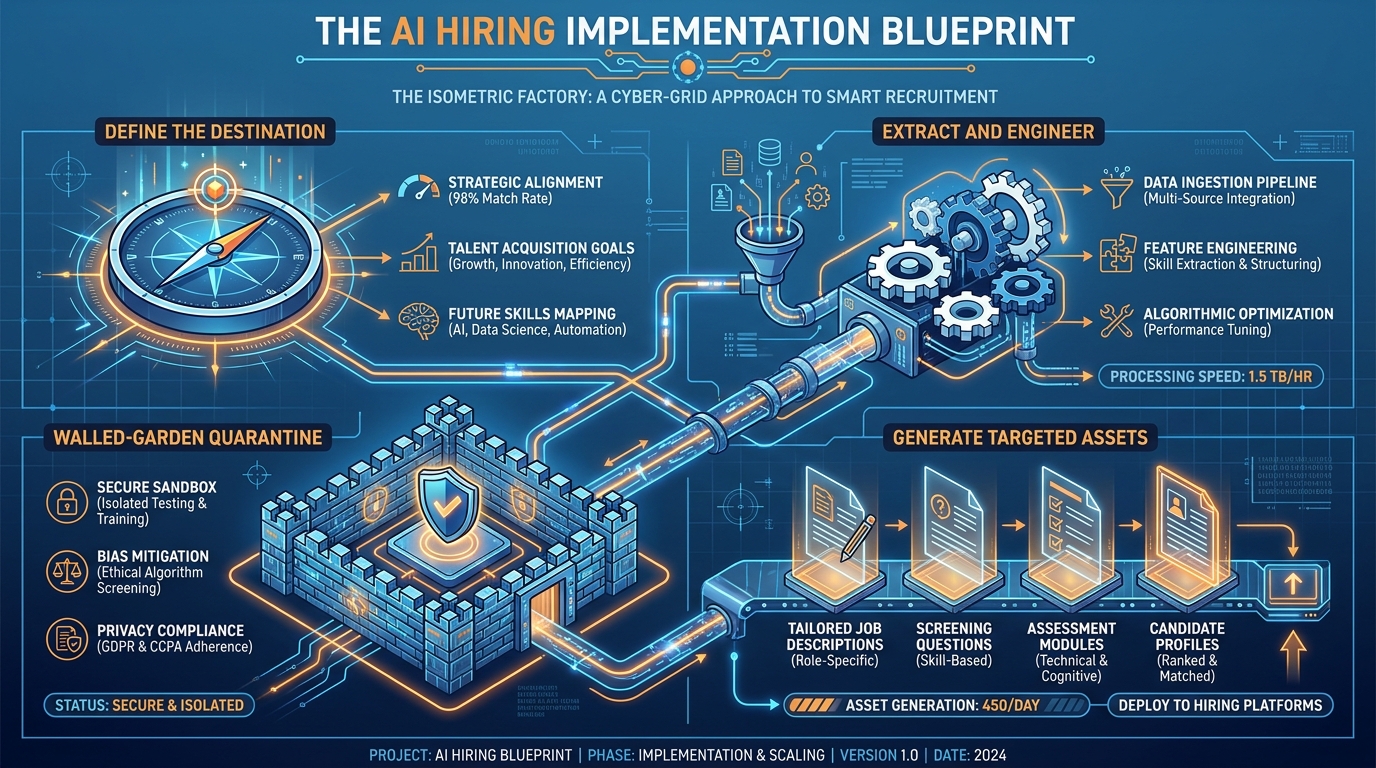
Step 1: The Human Work (Defining the Destination)
The Action: Before you even open an AI tool, you must do the foundational human work. You need to define the vision, the destination, and the aspirational outcome for this new role. What is the ultimate business objective this person is going to solve?
The Business ROI: AI is incredibly powerful, but it requires a compass. By clearly defining the aspirational destination, you ensure that the AI's analytical power is pointed in the right direction. This alignment guarantees that the eventual hire is not just filling a gap, but actively propelling the company toward its long-term strategic goals.
"We all know that we're probably not an expert at hiring, interviewing, identifying, placing, onboarding, and setting up for success, both your business and your new candidate. That's just hard." — Steve ROI Brown
Step 2: The Walled-Garden Quarantine (Locking in Your Reality)
The Action: Gather your internal data. In Steve's applied methodology, this meant gathering the transcripts from several months of project meetings (roughly 12 hours of raw, messy, unedited conversations). You then upload these specific transcripts into an AI environment like Gemini Notebook (or NotebookLM) as your exclusive Source documents.
The Business ROI: This is the most critical step for risk mitigation. By uploading these transcripts, you capture the actual, messy truth of how your team communicates, where projects fall through the cracks, and what specific skills are genuinely missing. By restricting the AI strictly to this Walled Garden, you eliminate hallucinations. The AI cannot default to a generic "industry standard" template because you have quarantined it within your exact business reality.
Step 3: Study, Extract, and Engineer (The Extraction)
The Action: With the data quarantined, you prompt the AI to interrogate the transcripts. You instruct it to study how your team works, identify the unique aspects of your daily operations, and extract the precise requirements needed to support this specific project. You then command the AI to generate a highly specific, bespoke job description based only on those internal observations.
The Business ROI: You bypass hours of exhausting cognitive labor. The AI rapidly synthesizes months of complex team dynamics and outputs a crystal-clear, highly targeted job description. This asset sets exact expectations for potential candidates. It ensures that the people applying are not just looking for a title, but are actually capable of adapting to your team's specific workflow.
"I have uploaded several months of project meeting transcripts. I want you to read how we actually work and strictly use those provided resources. Build this description out of that." — Steve ROI Brown
Step 4: Asset Generation and Interview Preparation
The Action: Once the bespoke job description is created, you use the same quarantined AI environment to generate targeted interview questions. Because the AI understands the nuances of your meeting transcripts, it will generate questions that test a candidate's ability to handle your exact internal challenges, rather than serving up generic questions like, "What is your greatest weakness?"
The Business ROI: This arms the interviewer with lethal precision. You are set up for total success because you can now vet candidates against the actual realities of the job. This directly decreases the odds of the dreaded 90-day churn, saving the business massive amounts of wasted capital, lost time, and diminished team morale.
See the Walled-Garden AI Framework in Action
While the philosophy behind this framework is transformative, seeing the mechanics in action is what bridges the gap between theory and execution. In the AI Made Simple episode, Steve ROI Brown breaks down the workflow in depth, showing exactly how to upload, quarantine, and interrogate your internal data using Gemini Notebook.
You’ll see how the three-pane architecture works: the raw project transcripts live in the Source/Quarantine pane, the Boardroom gives you a space to brainstorm and interrogate the data with AI, and the Output pane turns those insights into clear, actionable job descriptions and targeted interview questions.
By utilizing AI as a thinking partner to analyze your actual organizational data, you can stop guessing, stop relying on exhausted cognitive energy, and start engineering your talent pipeline based on your own internal evidence. Clarity wins.
Watch the full AI Made Simple episode on YouTube to see Steve walk through the process step by step and learn how to build the exact candidates your business actually needs.
Ready to Make AI Work for Your Team?
You don't have to figure all of this out on your own. If you can see opportunities for AI in your business but aren't sure where to start, a strategy and clarity session with Steve can help you make sense of it.
Together, we'll look at how your team works today, where you're losing time or creating unnecessary friction, and where AI can help your people work better. The goal isn't to add more technology just for the sake of it. It's to use AI as a thinking partner and practical tool to make your team better, more capable, and more effective.
Set up a strategy and clarity session with Steve today and discover where AI can make a real difference in your business.