
Why Logic Alone Does Not Win High Stakes Presentations and What to Do Instead
You can prepare for weeks, gather the numbers, build clean slides, and deliver a presentation that makes total sense. Then the decision is “no.” It feels confusing because your logic was solid. But high stakes decisions are rarely made by logic alone. They are made by people. People who are distracted, cautious, emotional, and influenced by the group around them.
Before we go further, this topic is also discussed in the AI Made Simple podcast. You can find the episode on YouTube if you want extra examples of how AI can help leaders communicate with more focus and imagination.
The real problem is not that your facts are wrong. The problem is that facts without emotional connection do not create movement. They create information.
This blog will show you how to move from clear to compelling, how to reveal what is truly at stake, and how to use AI to design presentations that stick.
The Leadership Trap: When Clarity Does Not Create Action
Many leaders fall into a simple trap: they assume that if people understand, people will act.
That is not how the brain works.
Logic helps people organize information. Logic makes things neat. Logic can even make you sound smart. But logic does not automatically create urgency, confidence, or buy in.
If you have ever presented a plan to your team and felt surprised by the lack of energy, you have experienced this trap. You explained it well. You answered questions. You showed the timeline. Yet people stayed hesitant. Or they pushed back. Or they simply did nothing.
Here is the hard truth: clarity alone rarely compels action.
To persuade, you need clarity plus something else.
The Three Forces That Make Your Message Stick
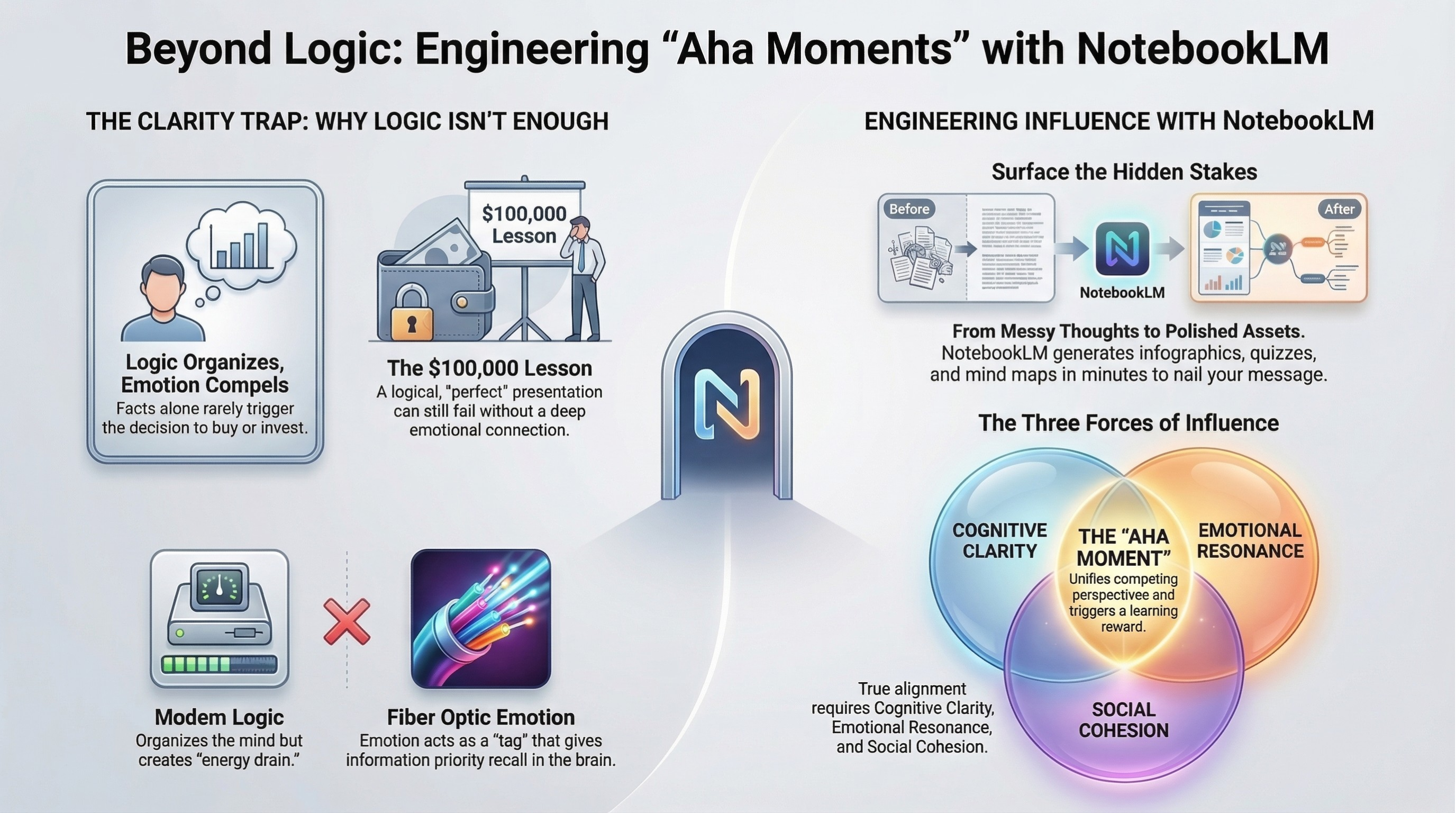
If you want your message to land, you need three forces working together:
Cognitive clarity. People can quickly understand what you mean.
Emotional resonance. People feel why it matters.
Social cohesion. People experience a shared “yes” together, not six separate opinions moving in different directions.
When these three overlap, your message does more than inform. It imprints.
It becomes the kind of idea people remember, repeat, and act on.
Why Emotion Speeds Up Memory and Decision Making
The brain does not store all information equally. It filters. It prioritizes. It tags what matters.
Think about something you learned years ago that you still remember. You probably cannot recall every detail, but you can recall the feeling. That feeling acts like a shortcut. It pulls the whole memory back faster.
That is why emotion is powerful in communication. Emotion becomes a “priority tag” in the brain.
A page of data can be accurate and still easy to forget. But a clear idea tied to a human feeling is easy to recall. And when people can recall your message, they are more likely to trust it and act on it.
So the goal is not to be dramatic. The goal is to make the meaning felt.
Make the Stakes Obvious or People Will Not Lean In
Most presentations fail because the stakes are hidden.
The audience does not feel the cost of doing nothing. They do not see what gets worse if they delay. They do not feel who is impacted. They do not picture the difference between “before” and “after.”
You can fix this by making the stakes visible in simple, direct ways.
Use clear contrasts like these:
Before vs. After
Problem vs. Possibility
Risk vs. Reward
Cost of Inaction vs. Benefit of Action
When stakes are clear, attention increases. When stakes are emotional, urgency increases.
Here is a simple rule: If the stakes are not obvious, your audience will treat your idea as optional.
The Aha Moment: How to Unify a Room Fast
In high stakes settings, the group is often fragmented.
You may have six decision makers with six different opinions. Even if they like you, they may not agree with each other. That slows everything down.
One of the fastest ways to unify a group is to engineer an “aha moment.”
An aha moment is not a fun trick. It is a learning moment where the audience suddenly sees something clearly. It creates a shared experience.
You have seen this in comedy and storytelling. A speaker builds a story, then reveals something unexpected that connects the dots. Everyone reacts together. That shared reaction creates alignment.
In business, an aha moment might be:
A simple insight that reframes the problem.
A surprising comparison that makes the risk feel real.
A visual that shows the hidden cost of the current approach.
A clear explanation that removes an insecurity or doubt.
The key is this: insight feels good because it resolves tension.
When people feel tension and then feel resolution, they feel confident. Confidence is a powerful emotion in decision making.
Your Audience Is Already in a Story, So Join It
People are not blank slates waiting for your plan. They are already living in their own story.
They have goals, fears, pressure, and doubt.
Your job is to connect your message to the story happening in their head, especially the internal struggle.
Most internal struggles sound like this:
“What if we choose wrong?”
“Do we have the budget for this?”
“Will this make me look foolish?”
“What if it fails and I am blamed?”
“Do we have what it takes?”
When you address those doubts directly, your message feels safer. When you show a path forward, your message feels useful. And when you show how your solution fits into their future, your message feels personal.
That is persuasion.
How AI Helps You Build Clarity and Emotional Impact Faster
Many leaders know they should tell better stories, but they do not have time. They may not have a team. They may not feel naturally creative.
This is where AI tools can help, especially tools designed to organize your thinking and turn messy ideas into clean assets.
A smart workflow looks like this:
Collect your sources. Gather your notes, documents, proposals, transcripts, or research.
Ask AI to structure the message. Have it organize your points into a simple story arc.
Pull out the stakes and contrasts. Ask questions like:
What happens if we do nothing?
Who is impacted the most?
What fear is hiding under the surface?
What opportunity are we missing?
What transformation is possible?
Generate supporting assets. Create a one page overview, a slide outline, a visual before and after, a short summary, and even a quick quiz for alignment.
This approach gives you speed without sacrificing depth. It helps you present with confidence because your story is organized and your emotional through line is clear.
Most importantly, it helps you stop relying on long blocks of text and start using visuals and structure that the brain can absorb quickly.
A Simple Formula You Can Use Today
If you want a practical way to check your next presentation, use this:
Can they understand it in one minute?
Can they feel why it matters in one minute?
Will the group experience a shared learning moment?
If you have all three, you are not just giving information. You are creating alignment.
Get Your Team Clear and Confident With AI
If your team has important decisions to make and you want your communication to land with more clarity and impact, set up a strategy or clarity session with Steve. We will help you turn your ideas into messages that people understand, feel, and act on. You do not need a huge team or weeks of preparation to communicate like a pro.
AI can give you the structure. The right strategy can give you momentum.
Book a session and let’s help your team lead better through the smart use of AI.