
Why Visual Storytelling Wins in Business Communication
Every day, leaders, marketers, and business owners face the same challenge: explaining something important quickly enough to keep people interested.
You may have a great idea. You may have a valuable service. You may even have the perfect solution to someone’s problem. But if people do not immediately understand what you do and why it matters, the conversation usually ends before it begins.
That is why visual storytelling matters so much.
Before we go deeper into this topic, AI Made Simple also explores these ideas through its podcast and video content. You can watch the show on YouTube to learn more about how AI tools can help leaders communicate with more clarity, creativity, and confidence.
Your Brain Prefers Pictures Over Paragraphs
Think about the last time you drove past a billboard.
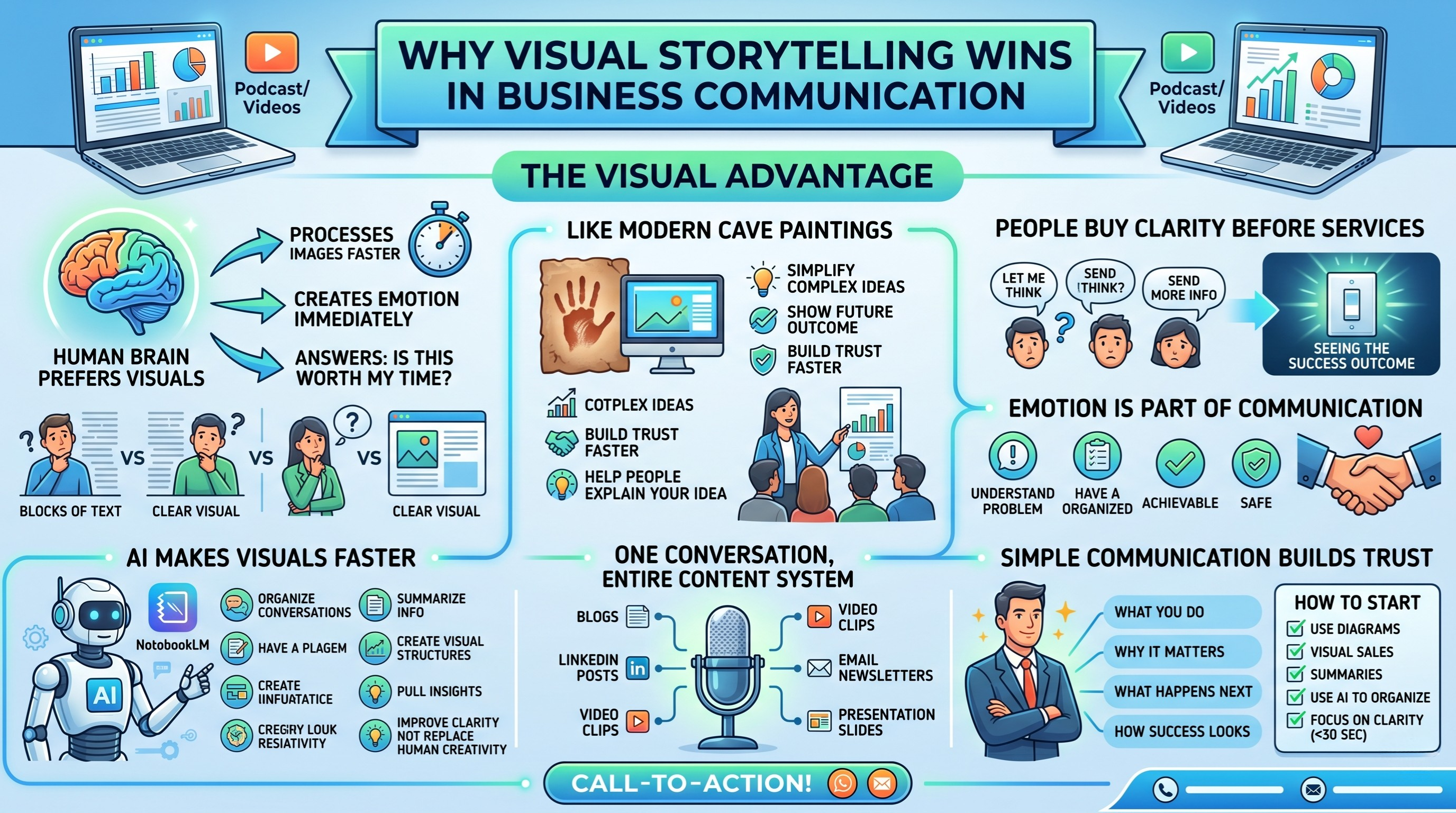
You probably noticed the image first before reading any words. That is not an accident. The human brain is wired to process visuals faster than text. Images create emotion immediately. They help people understand context in seconds.
This is why a simple infographic can often do more than a long email.
Many professionals make the mistake of overexplaining. They send giant blocks of text hoping people will carefully read every word. Most people will not. Busy executives, clients, and team members are constantly filtering information. They are asking themselves one question:
“Is this worth my time?”
A clear visual helps answer that question faster.
A Modern Infographic Is Just a Cave Painting
Long before websites, presentations, and social media existed, humans communicated through images. Cave paintings told stories, explained events, and shared ideas without long written explanations.
In many ways, infographics do the same thing today.
A good infographic can:
Simplify complex ideas.
Create emotional connection.
Show the future outcome clearly.
Build trust faster.
Help people explain your idea to others.
That last point is especially important.
Most decisions are not made by one person alone. Someone may like your idea, but then they need to explain it to their team, leadership group, or business partner. If they cannot clearly communicate your value, the opportunity often disappears.
Visual storytelling gives people tools to share your message accurately.
People Buy Clarity Before They Buy Services
One of the biggest hidden problems in business communication is confusion.
When people are confused, they hesitate.
This happens in:
Sales conversations.
Leadership meetings.
Client proposals.
Team presentations.
Marketing campaigns.
People rarely say, “I am confused.” Instead, they say things like:
“Let me think about it.”
“Send me more information.”
“We will revisit this later.”
“We are still exploring options.”
Often, the real issue is that they cannot clearly picture the outcome.
Visual storytelling helps people “see” the future.
When someone can picture success in their mind, they become more confident moving forward.
Emotion Is Part of Communication
Many businesses focus only on facts and information. But people do not make decisions based only on logic.
Emotion matters.
A strong visual creates a feeling. It communicates:
“We understand your problem.”
“We have a plan.”
“This feels organized.”
“This feels achievable.”
“This feels safe.”
That emotional response is powerful.
When someone says, “I can see how this would work,” they are not just talking about information. They are talking about confidence.
Visuals help people emotionally connect with an idea before they fully understand every detail.
AI Makes Visual Communication Faster
In the past, creating professional visual assets took a lot of time and design experience.
Today, AI tools are changing that.
Platforms like NotebookLM can help organize conversations, summarize information, and generate structured ideas that can later become infographics, presentations, and visual frameworks.
This changes the game for leaders and teams.
Instead of spending hours trying to organize thoughts manually, AI can help:
Pull insights from meeting transcripts.
Identify key themes.
Build content outlines.
Create visual storytelling structures.
Simplify complex explanations.
The goal is not replacing human creativity. The goal is improving clarity.
AI helps you communicate ideas faster while still keeping the human message intact.
One Conversation Can Fuel an Entire Content System
Another major advantage of AI-powered communication is content repurposing.
Many businesses struggle because they constantly feel pressure to create more content.
But often, the best content already exists inside conversations.
For example, a single recorded discussion can become:
Blog articles.
LinkedIn posts.
Short video clips.
Email newsletters.
Presentation slides.
Social media graphics.
Team training material.
This creates consistency across all communication channels.
Instead of starting from scratch every time, businesses can turn one meaningful conversation into an entire content ecosystem.
That saves time while improving message clarity.
Simple Communication Builds Trust
A lot of people believe sounding smart means sounding complicated.
Usually, the opposite is true.
The best communicators simplify complex ideas without removing their meaning.
Clear communication shows confidence. It shows understanding. It shows leadership.
That is why visual storytelling works so well. It removes unnecessary friction and helps people quickly understand:
What you do.
Why it matters.
What happens next.
How success looks.
When communication becomes easier to understand, trust grows faster.
How to Start Using Visual Storytelling
You do not need to become a professional designer to improve communication.
Start small.
Here are a few practical ways to begin:
1. Replace Long Explanations With Simple Diagrams
Instead of writing five paragraphs, create a visual flow showing the process.
2. Use Images During Sales Conversations
Help prospects picture the outcome instead of just describing it.
3. Turn Meeting Notes Into Visual Summaries
People remember visual frameworks more than text documents.
4. Use AI to Organize Your Thinking
Upload transcripts, notes, or ideas into AI tools and ask them to simplify the message.
5. Focus on Clarity Instead of Complexity
Ask yourself: “Can someone understand this in under 30 seconds?” If not, simplify further.
The Future Belongs to Clear Communicators
Attention spans are shorter. Competition is louder. People are overwhelmed with information every day.
The businesses that stand out will not necessarily be the ones with the most information.
They will be the ones that communicate most clearly.
Visual storytelling is no longer optional. It is becoming one of the most important leadership and business skills in the AI era.
The good news is that AI tools now make this easier than ever before.
You do not need to be a designer. You do not need a giant marketing department. You simply need a clear message and the willingness to communicate it visually.
Ready to Help Your Team Communicate More Clearly?
If your team struggles to explain ideas clearly, create consistent content, or turn conversations into business opportunities, it may be time for a strategy and clarity session with Steve Brown.
We help leaders and organizations use AI to simplify communication, strengthen messaging, and build systems that turn ideas into action. From visual storytelling to content workflows, we help teams communicate with more confidence and clarity in a fast-moving world.