
Why Your Best Ideas Get Ignored Even When They Make Perfect Sense
You can walk into a meeting with a logical plan, solid numbers, and a clear explanation, then still watch people leave unmoved. A week later, nothing changes. It feels confusing because the solution makes sense. But the real issue is not logic. It is memory, emotion, and group dynamics.
This topic is also covered in the AI Made Simple podcast, and you can find the episode on YouTube if you want a deeper walk-through of how AI can help you lead with more clarity and creativity.
The truth is simple: people do not remember information the way we hope they will. They remember what they felt, what they understood quickly, and what they experienced together. When you learn how persuasion works in a group, you stop blaming the audience and start improving the way you present ideas.
This is where modern AI tools can give leaders a real edge, especially when you need multiple stakeholders to align around one decision.
The Hidden Problem: Group Persuasion Is Not One Conversation
One-to-one persuasion is usually straightforward. You listen, identify the real problem, and connect your solution to what matters to that person. You can adjust as you go.
But group persuasion is different because you are not convincing one brain. You are trying to align several brains at the same time. And those brains often come with:
Different backgrounds. People hear the same message and interpret it differently because they have different roles and experiences.
Different incentives. Each stakeholder is optimizing for a different “win.” What looks like a great solution to one person may look risky to another.
Different social pressures. In a group, people worry about looking uninformed, careless, or wrong. That pressure can lead to silence, hesitation, and resistance.
This is why smart plans can stall. It is not always disagreement. It is often misalignment.
The Real Goal: Move From “Me” to “We”
In groups, the challenge is to move people from separate viewpoints into a shared viewpoint. You want a room full of “me” to become a team that thinks “we.”
That shift happens when people adopt a shared lens, almost like putting on the same glasses. Once they see the situation the same way, your solution starts to feel like the natural next step.
A fast way to create that shared lens is to teach the group something first.
When people learn something together, it creates common ground. It reduces uncertainty. It builds momentum. And it sets up your idea to land better because now everyone is working from the same starting point.
Why Facts Alone Fade: The Brain Prioritizes Emotion
Most leaders rely on rational explanation because it feels professional. Data, charts, bullet points, and detailed plans. These matter, but they do not do the whole job.
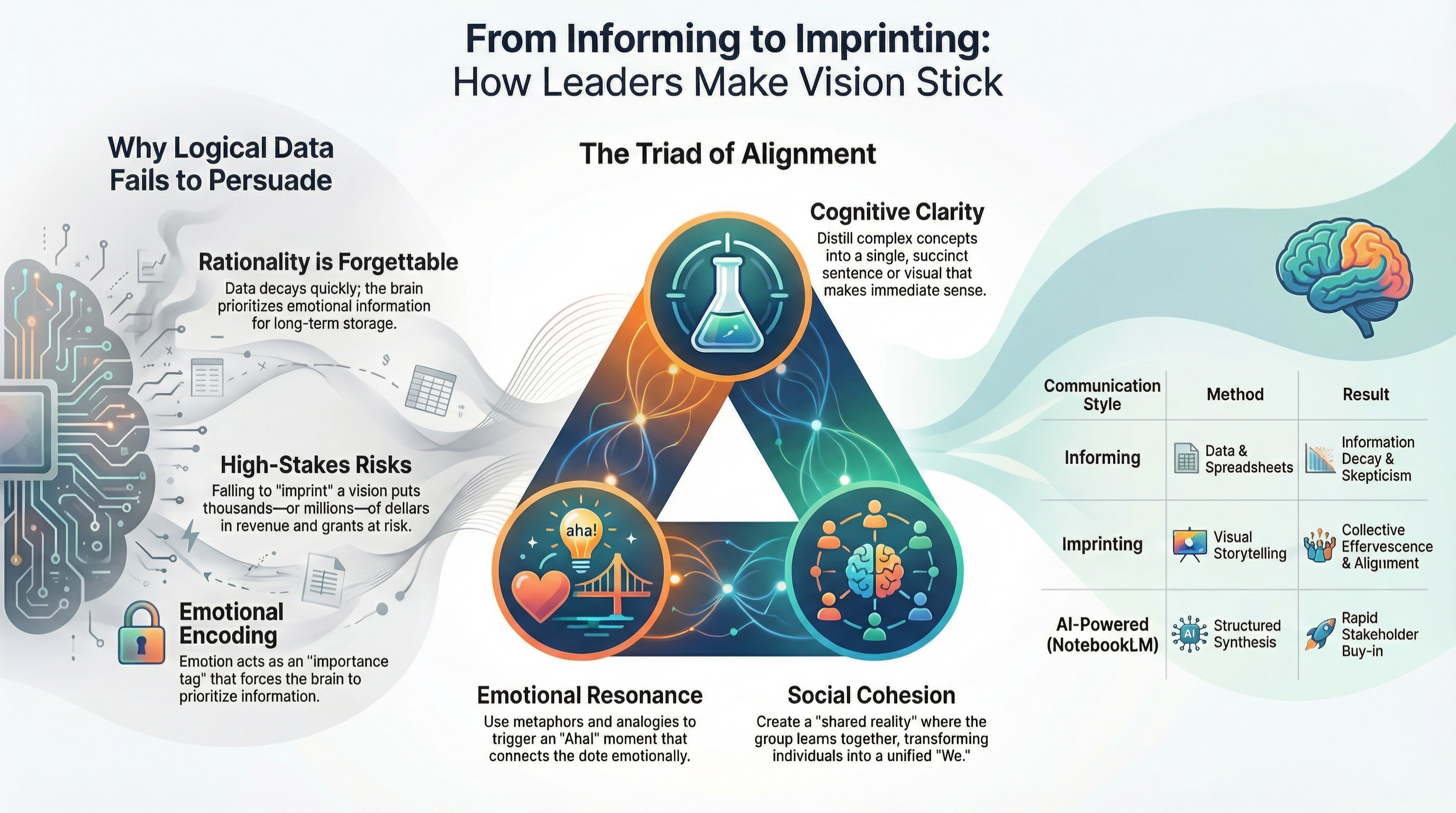
Emotion is what tells the brain, “Save this.”
Think of emotion like a priority label. When a message triggers feeling, the brain tags it as important. That is why people remember a funny moment, a powerful story, or a clear metaphor long after they forget the spreadsheet.
This is also why humor works so well. If something makes you laugh, it sticks. The feeling becomes part of the memory.
So if you want people to remember your message, you need more than information. You need a message that creates a moment.
The Three Requirements for a Message That Sticks
For your idea to land and stay with a group, you need three things working together. Think of it like a three-part lock. If one part is missing, the door does not open.
Cognitive Clarity
They must understand it quickly.
If you cannot explain your idea in one clear sentence, the group will struggle to repeat it later. People do not champion what they cannot summarize.
Clarity does not mean dumbing it down. It means removing clutter so the core idea is easy to carry.
Emotional Resonance
They must feel something.
This does not mean being dramatic. It means creating a spark through metaphor, story, or a vivid example. That emotional reaction is often the “aha” moment.
When people say, “Oh, I get it,” there is usually a small emotional lift in that moment. That lift is what makes memory stronger.
Social Cohesion
They must experience it together.
A group bonds when they share a meaningful moment. When they learn together, react together, and see the same insight at the same time, it builds unity.
This is why workshops, presentations, and team events can change behavior. Not because of the slides, but because of shared experience.
Visual Storytelling Solves All Three at Once
Visual storytelling is powerful because it can deliver clarity, emotion, and cohesion in one shot.
A good visual simplifies complexity into something people understand quickly.
A good metaphor creates feeling, which increases recall.
A shared “aha” moment creates group alignment.
This is also why many leaders admire great communicators. They can take a complex concept and make it feel obvious. But that skill usually takes years of practice.
AI now shortens that learning curve.
How AI Helps Leaders Communicate Better Without Becoming an Expert
Many leaders have strong ideas but messy inputs. Notes, voice memos, rough drafts, scattered documents, and half-formed concepts. The hard part is turning that into something clear and shareable.
AI can help you do that in a practical, repeatable way.
Here is the basic workflow:
Collect your raw thinking. Dump your notes, a draft, or even a rough explanation into an AI tool.
Ask for structure and named concepts. If you sense a pattern but cannot explain it, ask AI to identify what it is called and how it works.
Distill into key points. Pull out the core message, the best metaphor, and the simplest wording.
Generate visual assets. Turn the distilled message into an infographic or slide outline so you can present it clearly.
Create a reusable source of truth. Store the best version so your team can reference it later and stay aligned.
This is persuasive because it helps you show up prepared. And it is educational because it forces you to clarify your thinking.
When the stakes are high, clarity is not a nice-to-have. It protects deals, budgets, and trust.
What’s at Risk When You Don’t Communicate This Way
If you rely only on logic, three things often happen:
People forget the message quickly.
Complexity overwhelms them.
They struggle to repeat it to others.
And if your plan depends on them repeating it, championing it, or selling it internally, the whole effort can collapse.
This is why communication is not a soft skill. It is a leadership multiplier. When you improve it, everything else gets easier.
Set Up a Strategy or Clarity Session With Steve
If you want your team to move faster, align better, and communicate ideas in a way that actually sticks, set up a strategy or clarity session with Steve.
In that session, we will help you:
Turn messy thinking into clear messaging;
Build simple visuals that drive shared understanding;
Use AI tools to speed up leadership communication; and
Create a repeatable process so your team stays aligned.
AI is not just about efficiency. It is about leading with confidence, making ideas memorable, and helping people move together. If you want that advantage for your team, book a session and let’s build it.