

Why Your Message Needs Repetition to Stick
You can have a great product, a strong team, and real results, and still feel like people are not hearing you. Prospects stay unsure. Team members drift in different directions. Even your online presence feels scattered. It is tempting to think the problem is your offer, but often the problem is your story and how consistently it shows up.
Quick Note: Tis topic is also covered in the AI Made Simple podcast. If you want to go deeper, you can watch it on YouTube and see more examples of how AI supports clearer leadership and more creative communication.
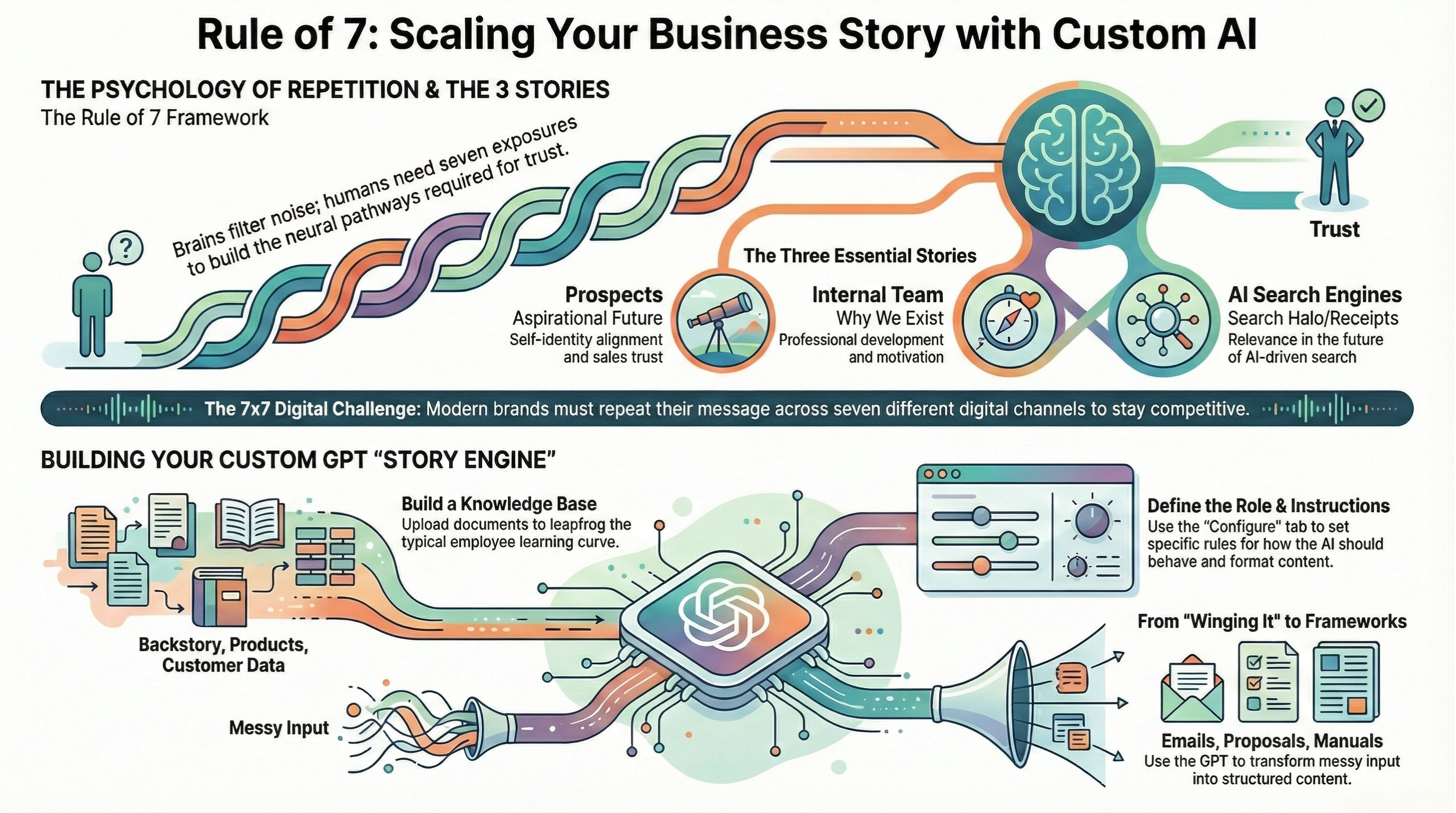
A simple idea explains a lot of this: people rarely believe a message the first time they hear it. They need repeated exposure before it feels familiar, safe, and trustworthy.
The Rule of Seven and the Brain’s Filter
Marketers often refer to the “rule of seven,” which means someone needs to encounter your message multiple times before they truly notice it and act on it. In today’s noisy world, you could argue it is more than seven, but the core insight is still helpful.
Why does this happen?
Your brain is designed to protect you from overload. Every day you are hit with endless inputs: ads, emails, social posts, meetings, notifications, and random ideas. So your brain filters aggressively. When something new shows up, your default response is caution. You might ignore it, doubt it, or delay deciding. Familiar information feels safer because it is proven and predictable.
With repetition, something changes. The message becomes recognizable. Recognition lowers resistance. Over time, trust starts to form because the idea no longer feels foreign.
This is not manipulation. It is how humans work.
Familiarity Builds Trust Faster Than Persuasion Alone
There is a reason a familiar face feels more trustworthy than a stranger. When you see someone repeatedly, your brain creates a shortcut: “I know this.” That sense of knowing is often the first step toward trust.
This matters in business because your customers are not only buying features. They are buying confidence. Confidence comes from clarity plus consistency. Repetition is what turns clarity into belief.
Here is a useful way to think about it:
First exposure: “Interesting, but I am not sure.”
Second and third exposure: “I have seen this before. What is it exactly?”
Later exposures: “I understand it. I trust it. I can see myself using it.”
The goal is not to say the same sentence over and over. The goal is to communicate the same core message in different ways, across different places, over time.
The Three Stories Every Organization Must Tell
Most organizations do not have one storytelling problem. They have three, because they are speaking to three audiences at the same time. If you only tell one story well, you still lose momentum in the other areas.
The Prospect Story: The Future They Want
Your marketing is not mainly about your company. It is about your customer’s future.
A strong prospect story answers:
Who is the customer today?
What problem are they facing?
What future do they want?
Why does your solution fit that future?
What success looks like after they choose you?
When this story is repeated consistently, prospects start to imagine a future where your product or service is part of who they are and how they succeed. That is powerful because people choose what feels aligned with their identity.
The Internal Team Story: Why We Exist and Where We Are Going
Your team needs a different story than your prospects. They need meaning, direction, and confidence.
A clear internal story helps people understand:
Why the company exists beyond making money.
What the mission looks like in daily decisions.
What standards matter and what “good” looks like.
How their role contributes to a bigger purpose.
Without this, people fill in the blanks with assumptions. That leads to mixed priorities, inconsistent customer experiences, and burnout.
A leader’s job is to repeat the internal story with consistency. Not once a year. Repeatedly.
The AI Search Story: What the Internet Learns About You
A newer challenge is that AI systems now play a role in how people discover and evaluate businesses. Your content is not only for humans anymore. It also teaches AI tools what you do, who you help, and what you are known for.
If your online messaging is inconsistent, the signals are weak. If your messaging is clear and repeated, the signals get stronger.
This does not require gimmicks. It requires a clean, consistent message and helpful content in the places your audience expects to find it.
Why This Feels Impossible for Smaller Teams
Large brands can hire specialists. They build research teams, content teams, and campaign managers. Smaller organizations often have to do all of that while also delivering the actual service.
That is why many owners feel stuck. They know storytelling matters, but they do not have the time to create seven versions of everything across seven channels while running a business.
This is exactly where AI can help, if it is set up the right way.
How a Custom GPT Becomes Your Storytelling Assistant
A custom GPT can act like a trained team member whose job is to support your messaging.
Instead of starting from scratch every time you need an email, a post, a proposal, or a training document, you start with a system that already understands your business.
To make this work, two elements matter most.
Clear Instructions
You define the role and rules. For example:
The tone you want.
The audience it is writing for.
The three stories it needs to support.
The formats you need most often.
This is like training a new employee. The clearer your expectations, the better the output.
A Knowledge Base
A custom GPT becomes more accurate when it can reference your real materials, such as:
Your website copy and offers.
Your brand language and positioning.
Your services and case studies.
Customer questions and objections.
Internal values and standards.
This helps the AI stop guessing and start sounding like your company.
What You Can Produce Faster With the Right Setup
Once a custom GPT is built around your three stories, you can use it to create consistent content across many channels.
For example:
Prospect-facing: landing page copy, sales emails, social posts, video scripts, FAQs
Team-facing: onboarding docs, culture reminders, meeting agendas, role clarity, SOP drafts
AI search-facing: helpful articles, question-based content, service pages, glossary pages
You still lead the strategy. The AI helps you execute faster and with more consistency.
The Real Benefit: You Stop Winging It
Many leaders rely on instinct. They “wing it” in meetings, in marketing, and in internal communication. Sometimes that works, but it is exhausting and hard to scale.
A strong framework plus a custom GPT helps you shift from reactive communication to repeatable communication.
You can give messy input and still get organized output. You can keep the message consistent without repeating yourself manually. You can show up more often without burning out.
Build Clarity and a Strategy That Scales
If you want your team and your market to truly hear you, you need more than motivation. You need clear stories, repeated consistently, supported by a system.
Set up a strategy or clarity session with Steve to map your three core stories and design a custom GPT that fits your business. We will help your team communicate better, stay aligned, and grow with confidence through the smart use of AI.