
Win High Stakes Presentations With Visual Storytelling and NotebookLM
You can do everything “right” and still lose the room.
You can show up with a polished proposal, perfect formatting, solid numbers, and a plan that makes total sense on paper. Yet the decision makers do not move. The judges do not vote your way. The buyers do not say yes. The board does not approve. It feels confusing because your logic is sound, but the outcome says otherwise.
The missing piece is often not the quality of your plan. It is the way the human brain decides what matters, what it remembers, and what it feels safe agreeing to.
Before we go deeper, this topic is also discussed on the AI Made Simple podcast. You can watch it on YouTube if you want extra examples of how AI can help you communicate with more focus and creative clarity.
Why Great Ideas Fail in the Room
Most high stakes presentations fail for one simple reason: the audience cannot quickly turn your information into meaning.
In group decisions, meaning is not just an individual experience. It becomes a shared experience. People are not only evaluating your idea. They are also watching each other, comparing assumptions, and negotiating risk. When the message is not clear or not memorable, the group drifts toward the safest option, which is often “no.”
Even if your plan is correct, your audience is battling distractions and stress:
Work pressure and mental load.
Messages, notifications, and competing priorities.
Personal issues they carried into the room.
Fear of making the wrong call in front of others.
Your audience is giving you a small window of attention. That attention is a gift. If you spend it on dense text and heavy data, you force the brain to do extra work. Many brains will opt out.
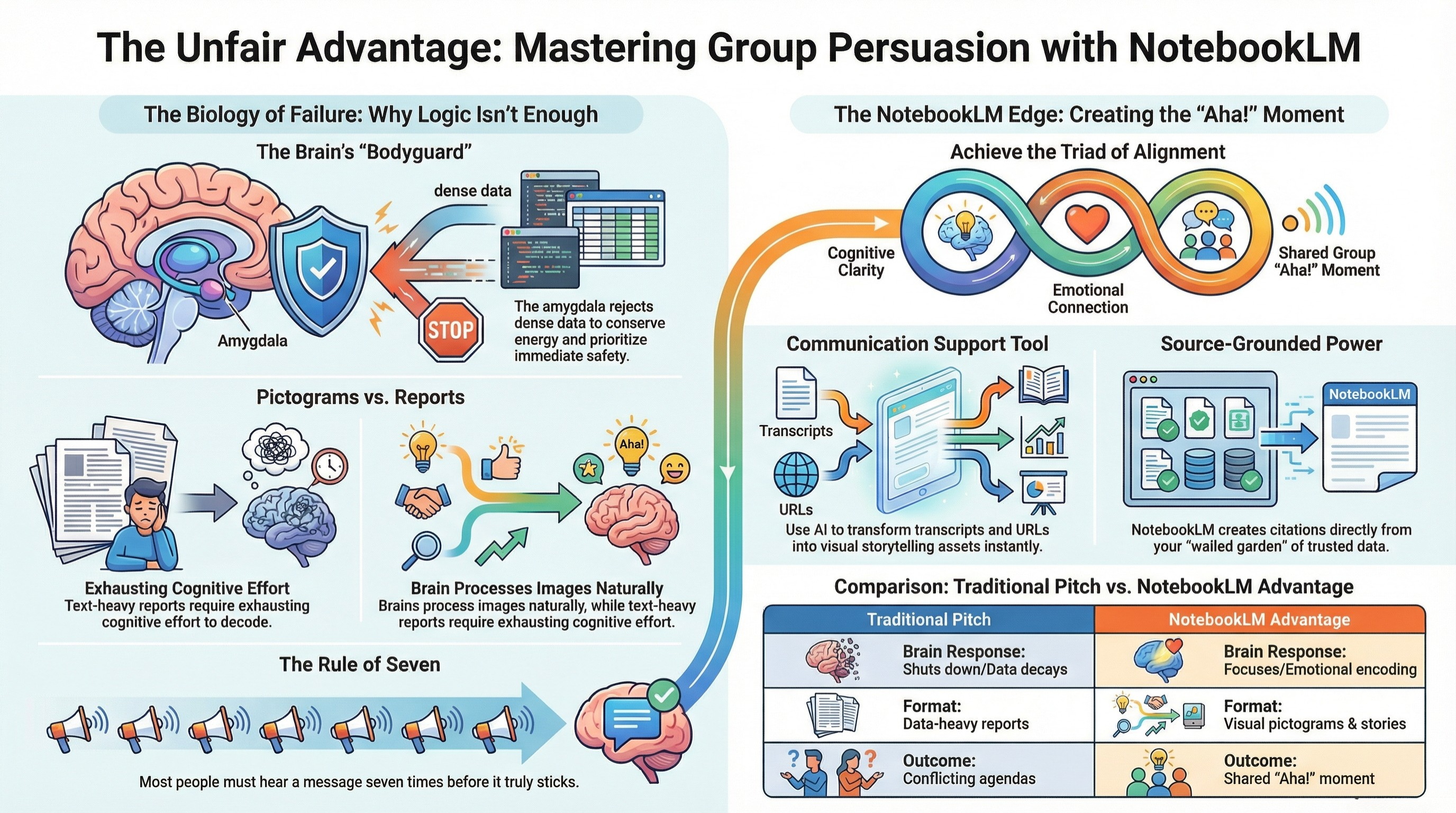
The Brain Has a “Bodyguard” and It Is Picky
A helpful way to think about attention is that your brain has a guard at the door. That guard has two main jobs:
Keep you safe.
Help you conserve energy.
Reading long blocks of text, processing complex slides, and tracking detailed arguments takes energy. In a meeting, the brain often decides, “This is expensive. I will come back to it later.” The problem is that “later” rarely comes, especially when the decision is being made right now.
This is why a data heavy deck can fail even when the data is strong. It asks the audience to do work they did not agree to do.
Why Visuals Create Faster Understanding
Humans are wired for pictures and story.
Long before we learned to read, we learned to understand the world through images, patterns, and simple narratives. Even today, a basic drawing can communicate an idea instantly, across cultures and education levels.
Think about a simple sketch of a family standing in front of a house. You understand the scene right away. You do not need a paragraph to decode it. The image lands quickly, and it often triggers emotion too, even if that emotion is subtle.
That is the advantage of visuals. They reduce cognitive strain and increase comprehension speed.
The Three Ingredients of a Group “Aha” Moment
If you want a group to align, you need more than information. You need an experience that brings people to the same conclusion at roughly the same time. That is what creates momentum.
There are three parts that make this happen.
Cognitive Clarity
Your audience must understand the point quickly. Not in 10 minutes. In the first minute.
Clarity means:
A simple story arc: problem, tension, solution, next step.
A clear “why now” that explains urgency.
A clear definition of success.
Emotional Connection
People decide with emotion and justify with logic. If your presentation has no feeling, it is easy to forget and easy to reject.
Emotion does not mean being dramatic. It means showing what is at stake:
What pain continues if nothing changes.
What becomes possible if the group says yes.
What risk is reduced by your plan.
When people feel the impact, they pay attention longer.
Shared Insight
In group settings, alignment happens when the group experiences the same breakthrough together.
You have seen this in workshops or meetings where a new concept finally clicks and everyone starts nodding. The energy changes. People feel like they now have a path forward. That shared lift is powerful.
When you combine clarity, emotion, and shared insight, you create the “aha” moment that moves groups toward agreement.
How NotebookLM Gives You an Unfair Advantage
NotebookLM can help you turn messy information into clear, visual, story based assets that support group alignment.
The key difference is that you bring your own source materials, like documents, web pages, transcripts, or meeting notes. Then you ask NotebookLM to transform that information into outputs you can actually use.
Here are practical ways it can help.
Turn dense info into visual summaries.
Instead of presenting a wall of text, you can generate:
One page visual overviews.
Simple infographics.
Mind maps or structured outlines.
These help people “see” the idea quickly.
Build story first, slides second.
Many people build slides as a data dump. A better approach is:
Ask NotebookLM to extract the core narrative.
Identify the tension and the decision point.
Turn each key moment into a visual slide.
This keeps your deck focused and easier to follow.
Create alignment tools for after the meeting.
Group decisions often stall because people need to explain the idea to others later. NotebookLM can generate “leave behind” assets, such as:
A one page recap of what was agreed.
A short explainer script for leaders to reuse.
A quick FAQ that addresses predictable objections.
That helps your idea survive past the room.
A Critical Rule: Your Results Depend on Your Sources
NotebookLM is only as strong as what you feed it.
If your sources are messy, outdated, or unclear, your outputs will be too. If your sources are sharp, well written, and relevant, the outputs improve dramatically.
Before you build assets, gather sources like:
The actual proposal or plan.
Supporting research you trust.
Notes from stakeholder interviews.
Clear descriptions of the problem and desired outcomes.
Then let NotebookLM help you organize and express the ideas.
A Simple Game Plan You Can Use This Week
If you have a big pitch, board presentation, or sales presentation coming up, try this process:
Collect your best source material in one place.
Ask for a clear narrative outline with problem, stakes, solution, and next steps.
Generate a one page visual summary that shows the “big picture”.
Create 5 to 7 slides only, each tied to one clear idea.
Add one shared “aha” slide, the moment where everything clicks.
Prepare a short leave behind recap for alignment after the meeting.
This approach respects the brain. It reduces effort, increases clarity, and makes it easier for a group to say yes together.
Ready to Help Your Team Communicate With More Clarity?
If your team is making high stakes decisions and your message is not landing, you do not need more data. You need clearer communication that matches how people actually think and decide.
Set up a strategy or clarity session with Steve to map out how your team can use AI tools like NotebookLM to sharpen your story, create stronger visuals, and lead conversations that drive real agreement. We will help your team communicate better, move faster, and build confidence through practical AI use.